AI Overviews on Job Searches: Evaluating 600 queries in US, UK, DE
This is part 1 of a 2-post Google series introducing AI Overviews for transactional job searches.
Google now shows an AI Overview on almost every second transactional job search in the US and the UK. We checked 600 queries like "remote jobs", "construction jobs" and "night shift jobs" on September 26: 48% had an AI Overview in the US, 47% in the UK, and 5% in Germany. Informational searches like "how to write a cover letter" have had AI Overviews for more than a year, and most job boards have written that traffic off by now. Transactional searches are different. The person typing wants a list of open jobs and nothing else, and these are the searches job boards live on.
I have to correct myself a bit here. In July 2025, in our webinar on AI agents for employer pages, I said transactional keywords are relatively safe from AI disruption, because you cannot summarize a list of job openings in an AI Overview. Turns out you can. The AI Overview now lists individual openings, with employer, pay and posting date. It just does not link to any of them (yet).
If you read Google Jobs is Broken Again, you remember the Chicago example from September 2: nothing fresh in the Jobs tab for "accounting jobs in Chicago", but current jobs with links to the boards in AI Mode. I wrote then that the new AI surfaces looked well fed while the classic Jobs module was starving. I now think the outage and the AI Overviews on job searches are connected. Google is wiring job data into its AI features, and the old Jobs pipeline broke along the way. I cannot prove it (Google isn't talking, as usual), but it is the only explanation that fits both.
This is a two-part series. In this first part, I explain how a Google result page is built, what transactional keywords are, and what a job search looks like with an AI Overview on top. Then I go through our study: how we sampled the 600 queries, how often an AI Overview showed up in each country, and whether the result holds when you check the same query again a few days later. Part 2 covers what the AI Overviews actually say, who gets cited, and what it means for job boards.
How Google builds a search result page
Google Search works in three steps. Crawlers (Googlebot) discover and download pages. Google processes each page and stores what it learned in its index, a huge database of pages and signals. When someone searches, Google pulls the matching pages from the index, ranks them and serves the result page (Google's How Search Works documentation has the long version).
The third step matters here. A result page has not been ten blue links for a long time. Google assembles it from blocks and decides, per query, which blocks appear and in what order. Search for a restaurant, and you get a map. Search for a job and you get Google Jobs.
Those blocks come in two kinds. Paid blocks are the ads, labeled as sponsored, and the advertiser pays for every click. Everything else is free: the organic results and SERP features like Google Jobs, Job Sites, People Also Ask and now the AI Overview. Nobody pays to appear in Google Jobs or to get cited in an AI Overview. Keep this split in mind. When a new free block lands at the top of the page, it takes its clicks first from the free blocks below it.
For job searches, two SERP features matter. Google Jobs launched in the US in June 2017 and aggregates postings from job boards, ATS and career sites through JobPosting structured data (and the Indexing API, for those who still have quota 😊). Clicking a job opens a job detail view hosted by Google, and only the second click goes to the job board. Job Sites is a carousel that links straight to category pages of job boards and aggregators, which I covered in Google Testing Job Sites SERP Feature Above Google Jobs. This feature is only available to European sites.
What are transactional keywords
Search intent is the reason behind a query, and SEOs split it into four types. Informational queries ask a question ("how to become a product manager"). Navigational queries look for a specific site ("indeed jobs"). Commercial queries compare options ("indeed vs linkedin"). Transactional queries want to act ("product manager jobs berlin").
Transactional job keywords follow a predictable pattern: [occupation] + [location] + jobs. Think "accountant jobs london", "data analyst jobs remote" or "nurse jobs near me". The person behind them wants to see open jobs and apply. These keywords bring applications, and applications are what job boards sell, whether they charge per posting, per click or per applicant. A category page like /product-manager-jobs-berlin exists to rank for exactly one of these queries, and a job board with a solid taxonomy has tens of thousands of them. These combinations can really go into the long-tail and become very complex, like "retail part-time assisant jobs retail new york"
Until recently, AI Overviews mostly left these queries alone. Semrush found that between October 2024 and March 2025, 88% of the keywords triggering AI Overviews were informational and only 1.76% transactional. Their latest study of 600,000 US keywords (November 2025 to April 2026) shows AI Overviews on commercial keywords up 71% and on transactional keywords down 5%. Seer Interactive's 2026 study of 5.47 million queries found AI Overviews on 36% of informational queries and only 5% of transactional ones. In Germany, SISTRIX found that Booking.com lost 0.46% of its organic clicks to AI Overviews and Amazon 1.73%, and concluded that sites enabling transactions instead of answering questions remain largely spared.
So most SEOs I talk to worked with a simple rule in 2026. AI Overviews take informational traffic; transactional pages are safe. For job searches, that rule no longer holds.
What a job search looks like now
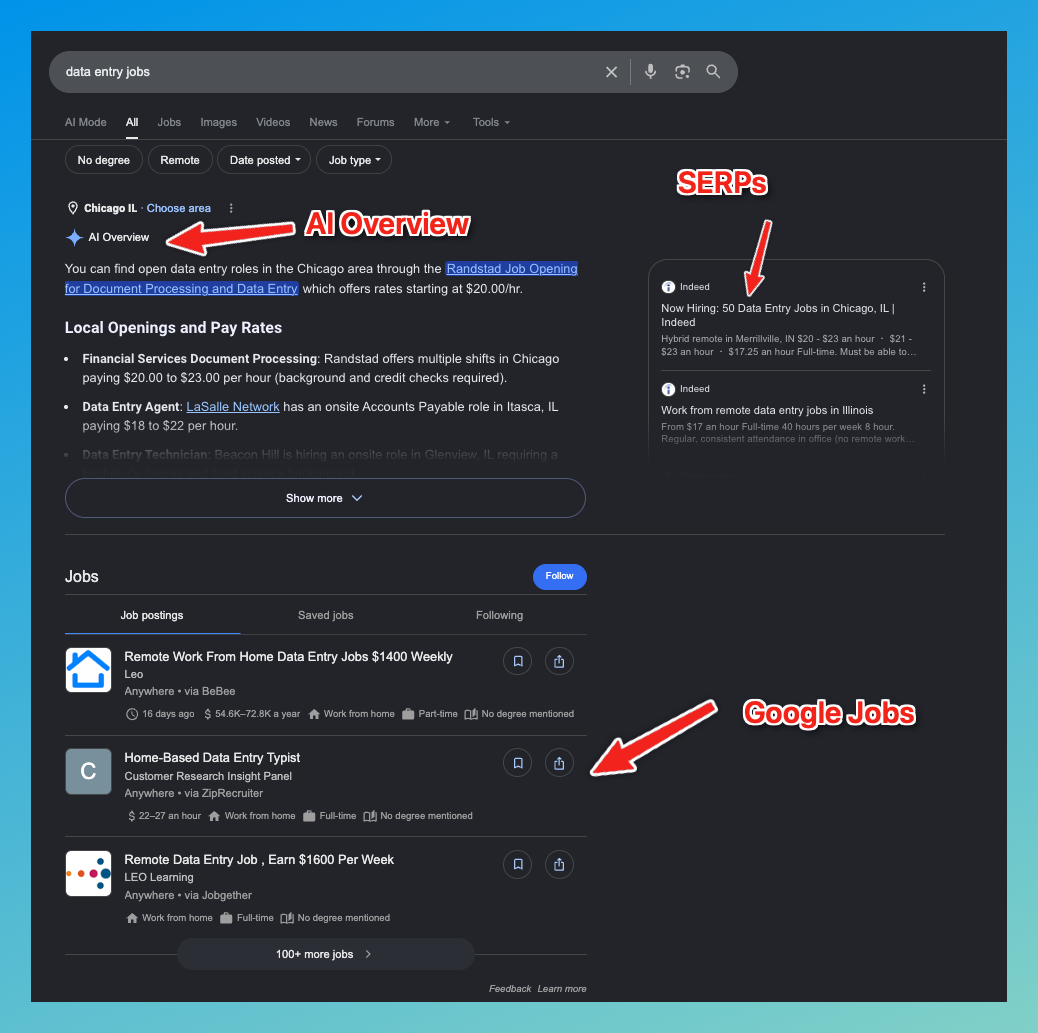
Data Entry Jobs
On September 25, I searched "data entry jobs". The AI Overview sits right below the filters - both on Desktop and Mobile.
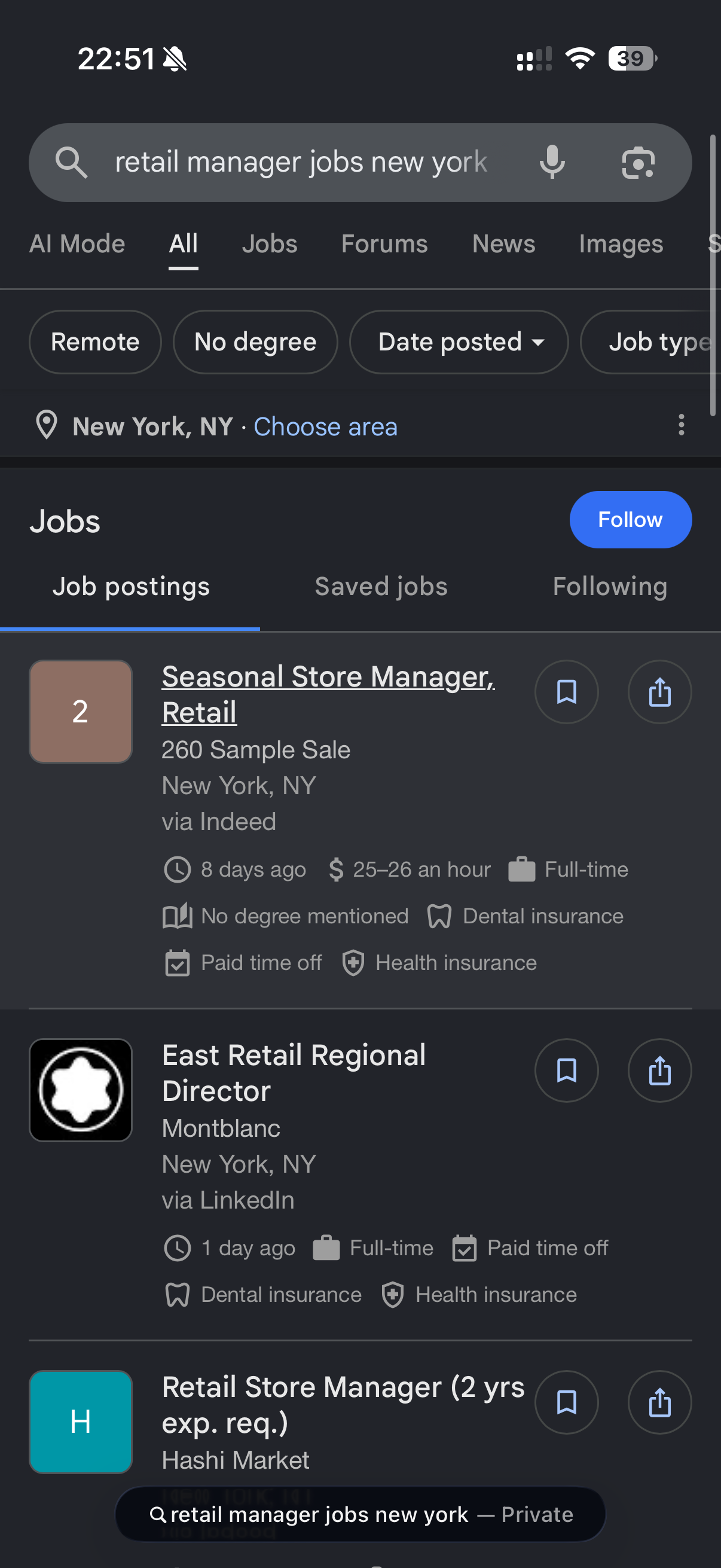
It gets more interesting when I search for "retail manager jobs New York". This search does not trigger an AI overview.
However, applying the "yesterday" filter to it triggers an AI search.
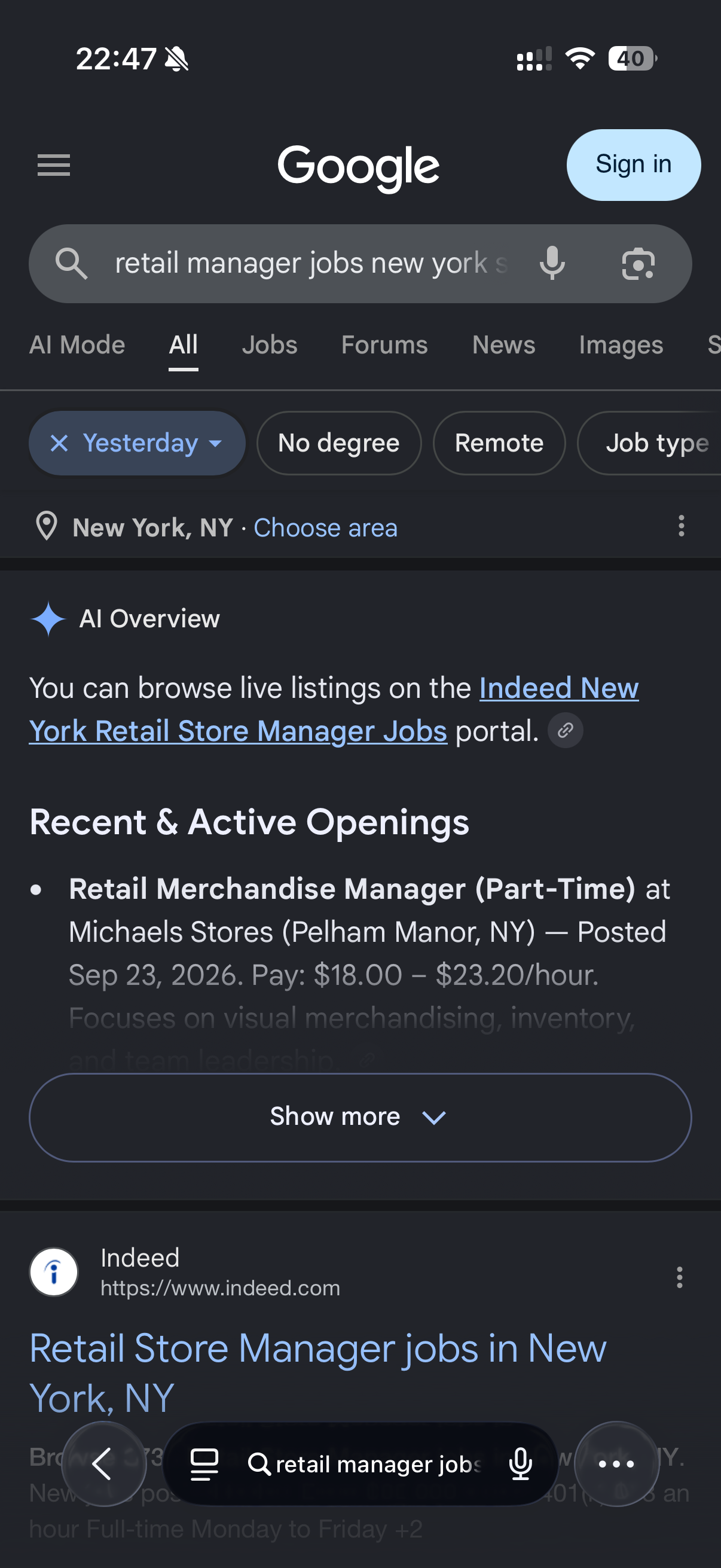
It opens with "You can browse live listings on the Indeed New York Retail Store Manager Jobs portal", then lists "Recent & Active Openings": a part-time Retail Merchandise Manager at Michaels Stores in Pelham Manor ($18.00 to $23.20 an hour), a Store Manager in Training at CVS Health in Brooklyn, a Flex Manager at By the Way Bakery. After that comes a "Market Overview" with the average store manager salary in New York ($57,143 a year, cited to ZipRecruiter), pointers to LinkedIn and Glassdoor, and an offer to narrow down the listings by borough, type of retail and salary.
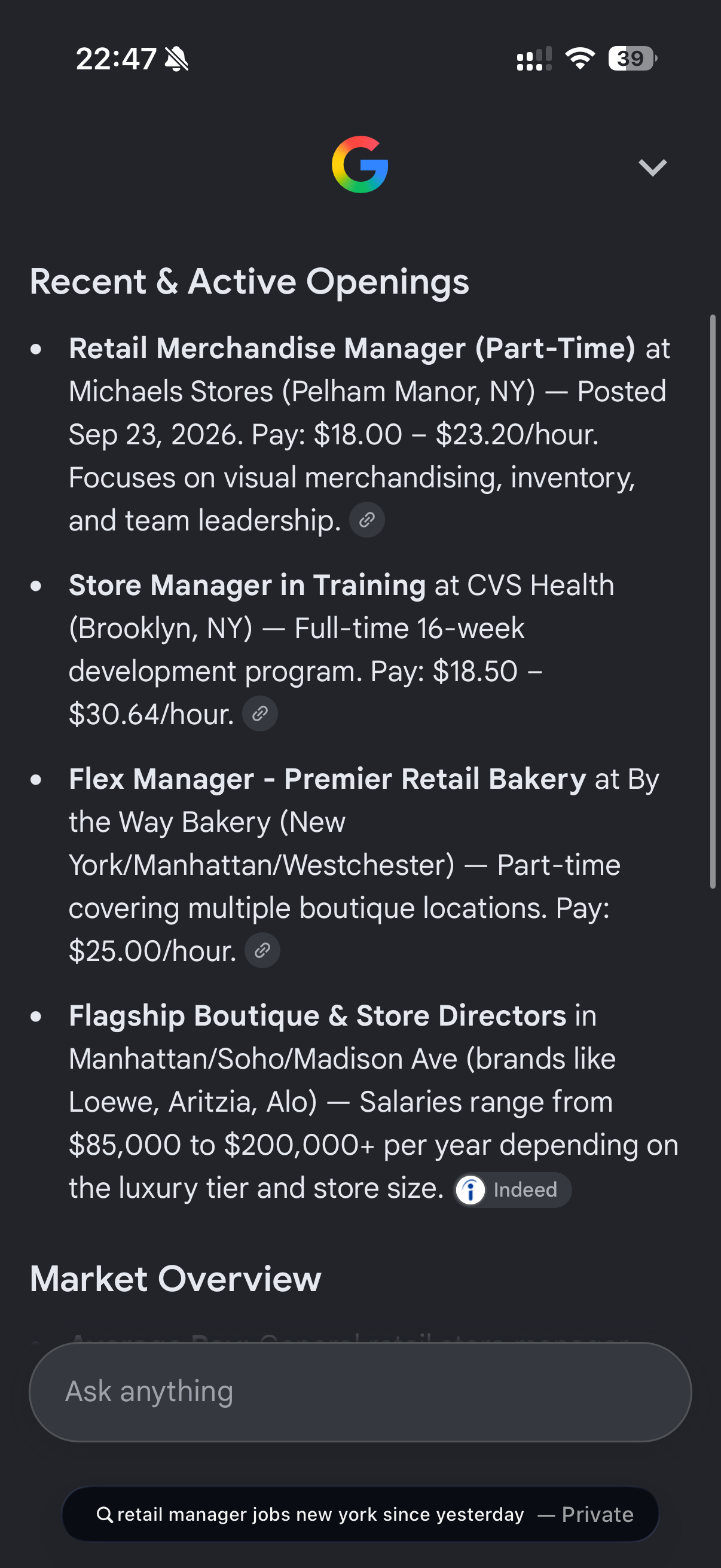
Now try to apply to one of these jobs. You can't, at least not from the AI Overview. None of the links lead to an actual job posting. The small link icons next to the Michaels or CVS Health jobs go to homepages. A job seeker who wants the Michaels job has to find it again, in Google Jobs, on a job board, or by asking the AI Overview for more. So yes, you can summarize a list of jobs in an AI Overview. Google just hasn't linked them yet, and I wouldn't bet that will last long.
Below the AI Overview, Indeed's category page sits as the first organic result. Google Jobs comes third, and it starts exactly where the first screen ends. Remove "since yesterday" from the query and, in my test four minutes later, the AI Overview was gone and Google Jobs was back on top.
One more detail made me smile. I used the "Yesterday" filter, and Google Jobs respected it: its first two jobs were posted 21 and 13 hours earlier. The AI Overview did not. Its first listing, the Michaels job, was posted two days before my search. Google Jobs had the fresher jobs, and the AI Overview got the better spot.
And AI Overviews are not small. BrightEdge measured an average height of about 1,200 pixelsin February 2026, against a standard desktop viewport of about 900 pixels. On mobile, Tom Capper's pixel study found that the first organic result is not visible without scrolling in roughly three out of five searches. My New York example shows what that means for jobs: even collapsed, one AI Overview and one organic result are enough to push Google Jobs off the first screen.
Berlin: "handwerker jobs berlin"
Germany looks different, and in one way more radical. Shortly after midnight on September 26, I searched "handwerker jobs berlin". The AI Overview opens with links to Indeed's "Handwerk Jobs in Berlin" and Kleinanzeigen's "Handwerker" pages. Under "Current Job Openings in Berlin", it names employers instead of jobs (Allrounder Stelter, Miton Elektro GmbH, Dennis Hausmeister-Service), with hourly pay from around 15 €, followed by a salary overview and the same kind of follow-up question as in New York. (The AI Overview answered in English, same as the Google interface on my phone. The results below it are German.)
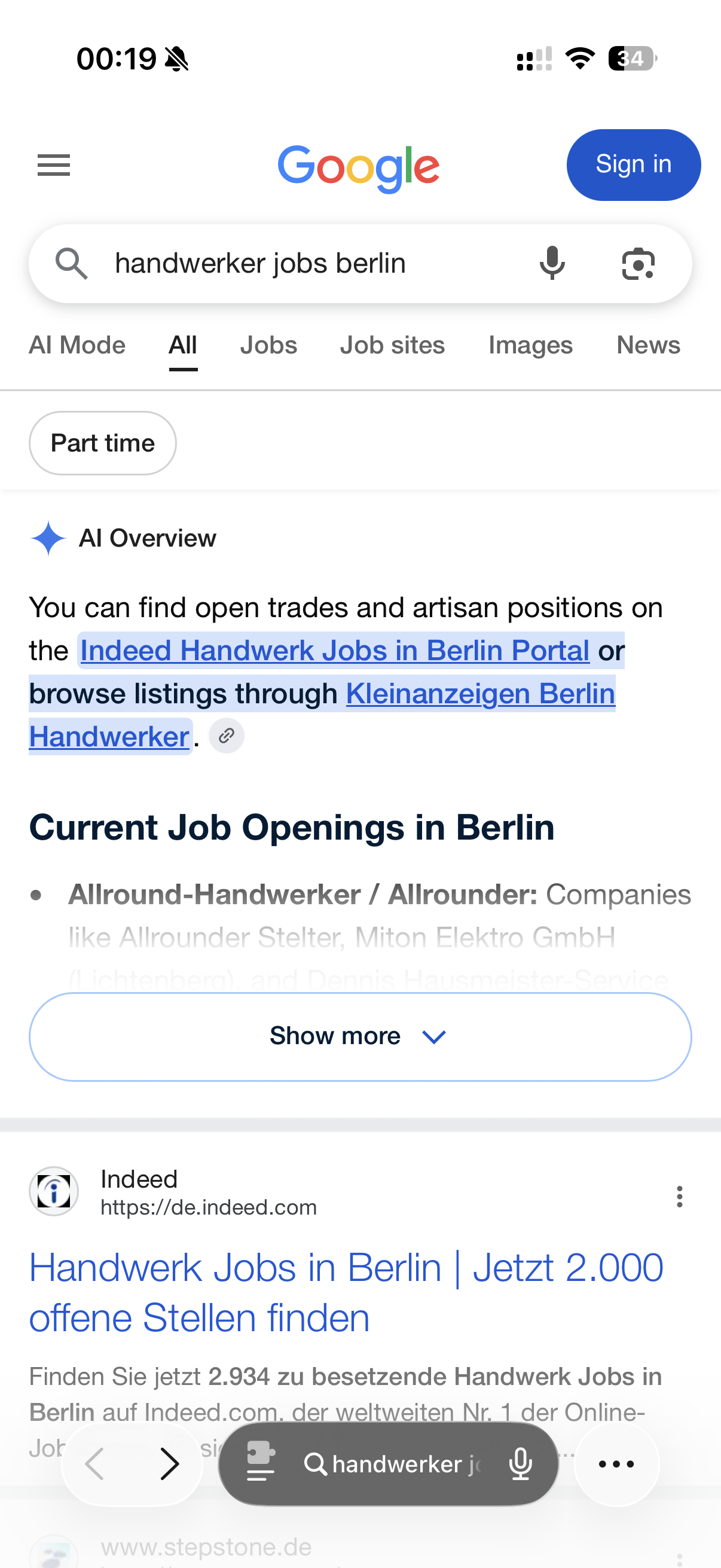
Two things stand out. First, there is no Google Jobs block on the page. Below the AI Overview come three organic results, Indeed, StepStone and Kleinanzeigen, and then People Also Ask. Google Jobs only exists behind the "Jobs" tab at the top.
Second, the links go to category pages, and they are exactly the top three organic results. At the bottom of the expanded AI Overview, the source cards show the same three pages again. Every one of them appears at least twice on the page, once inside the AI Overview and once as an organic result.
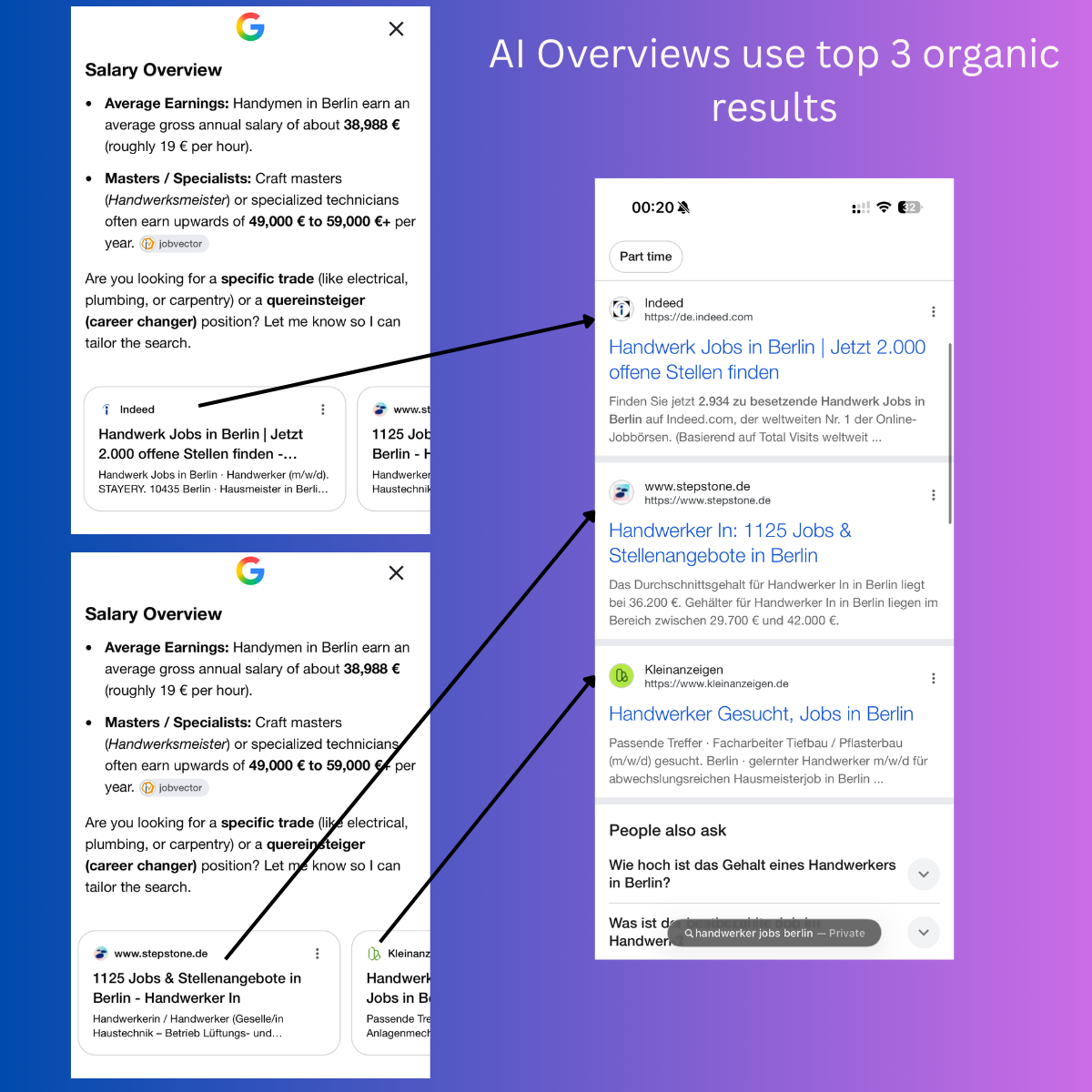
In New York, the AI Overview pushed Google Jobs down. In Berlin, Google Jobs was not on the page at all.
Google has tried to put things above Google Jobs before
The top of the job SERP has been Google's testing ground for years. For most of Google Jobs' history, the standard US layout was sponsored text ads from Indeed, ZipRecruiter and friends at the top, then Google Jobs, then the organic results.
In March 2023, Tom Chevalier from Appcast spotted the first Google Job Ads. For about a year, Google tested sponsored job cards above the Google Jobs module, a slider with five job ads and four collections. Radancy described them as appearing "outside the Google for Jobs search results themselves vs. directly inside of them". In early 2024, Google killed the product before it ever launched (I wrote about why Google killed Job Ads at the time). Job Sites went through the same kind of testing: above Google Jobs in early 2024, below it at launch, and back on top in recent tests.
For a short period of time, back in 2025, Google also tested showing traditional search ads above Google Jobs, but this behaviour has largely disappeared.
So Google tried ads above Google Jobs, and it tried job board category pages above Google Jobs. The AI Overview combines both ideas. It lists individual jobs, much like the job ad cards did, it links to job boards, and in the US it can carry ads. Google shows ads in AI Overviews in the US and, according to its documentation as of December 2025, in 11 more markets including Canada and Australia, in English only. The UK and the EU were not on that list.
How we measured it
Screenshots are anecdotes, so we measured it. We built a set of 600 transactional job queries, 200 each for the US, the UK and Germany. Every query contains the word "jobs", so this is deliberately the commercial end of job search ("remote jobs", "night shift jobs", "homeoffice jobs"), not "how to write a CV". We removed brand and navigational queries like "indeed", "usajobs" or "jobbörse", so no query is a shortcut to one company's site.
We sampled the queries by absolute monthly search volume, using the same volume bands in all three countries so the rates stay comparable. The sample is seeded and reproducible.
We scraped the Google result pages on desktop, from an IP address in each country, using the local Google and language: google.com in English for the US, google.co.uk for the UK, google.de in German for Germany. Every query was checked twice in the same week, between September 18 and 26, 2026. The gap between a query's two checks is 2 to 7 days, because we wanted to have some variability.
One more thing, because this is a post about AI: no language model produced any of the numbers below. We used an LLM for two chores only, filtering brand queries out of the sample and classifying cited domains (is this a job board or not?). Everything else is counted from the stored result pages.
How often job searches get an AI Overview
On September 26, all 600 queries ran on the same day with the same method, so the three countries are directly comparable.
| Country | Queries with an AI Overview | Of those, also with a Google Jobs box |
|---|---|---|
| US | 95/200 (48%) | 85/95 (89%) |
| UK | 94/200 (47%) | 79/94 (84%) |
| Germany | 10/200 (5%) | 0/10 (0%) |
| All | 199/600 (33%) | 164/199 (82%) |
In the US and the UK, almost every second transactional job search has an AI Overview. Compare that with what the industry assumed about transactional queries: Seer found AI Overviews on 5% of them, and Semrush saw them shrinking on transactional keywords until April. Those are different datasets, from different months, across all industries, so I would not put them in one chart with ours. But a gap of 48% against 5% is hard to explain with method alone. Either job searches have been treated differently all along, or something changed since spring. Two checks in one week cannot tell which.
The last column matters just as much. In the US, 89% of the AI Overviews share the page with a Google Jobs box, in the UK 84%. In English-speaking markets, the AI Overview does not replace Google Jobs. It competes with it for the same screen, like in my New York screenshot, where it pushed Google Jobs below the fold. In Germany, none of the 10 AI Overviews came with a Google Jobs box, which is what my Berlin screenshot showed as well.
Germany is the story
5% against 48% and 47%, with the same queries, on the same day, with the same method. For context, SISTRIX measures AI Overviews on just over 20% of all German keywords. So German job searches get an AI Overview at roughly a quarter of the German average, while US and UK job searches sit right at the level trackers report for US search overall (43% from Similarweb and 48% from the Semrush Sensor in July).
I have two explanations and I cannot separate them with this data. The first is language: Google may simply be further along with job answers in English. The second is regulation. Germany is in the EU, under the Digital Markets Act and an EU antitrust investigation into AI Overviews since December 2025, with the Google Shopping case and the Jobindex lawsuit in the rear-view mirror. The UK is outside the EU and looks like the US. But the UK is also English. The market that would settle it is Ireland, English-speaking and in the EU. If we run another round, that is the one I would add.
Either way, it looks a lot like what I wrote in my HR Tech predictions for 2026: Google plugs jobs into AI search in the US first, and Europe follows later, if regulators allow it. The UK is not waiting for Brussels to "green light" this.
A caveat on my own screenshots: the Berlin search had an AI Overview, and the study says that is rare in Germany. Both are true. The study runs on desktop, from an IP address somewhere in Germany. My screenshots are mobile, in a specific city. AI Overview presence varies with device and location, so read the 5% as a desktop number for Germany as a whole.
The long tail is not safe
We split the 600 queries into volume thirds, with the cut-offs pooled across countries so the columns stay comparable: long tail up to 590 searches a month, mid tail 590 to 5,400, fat tail above 5,400.
| Country | Long tail | Mid tail | Fat tail |
|---|---|---|---|
| US | 24/60 (40%) | 20/60 (33%) | 51/80 (64%) |
| UK | 22/50 (44%) | 30/74 (41%) | 42/76 (55%) |
| Germany | 6/96 (6%) | 1/70 (1%) | 3/34 (9%) |
| All | 52/206 (25%) | 51/204 (25%) | 96/190 (51%) |
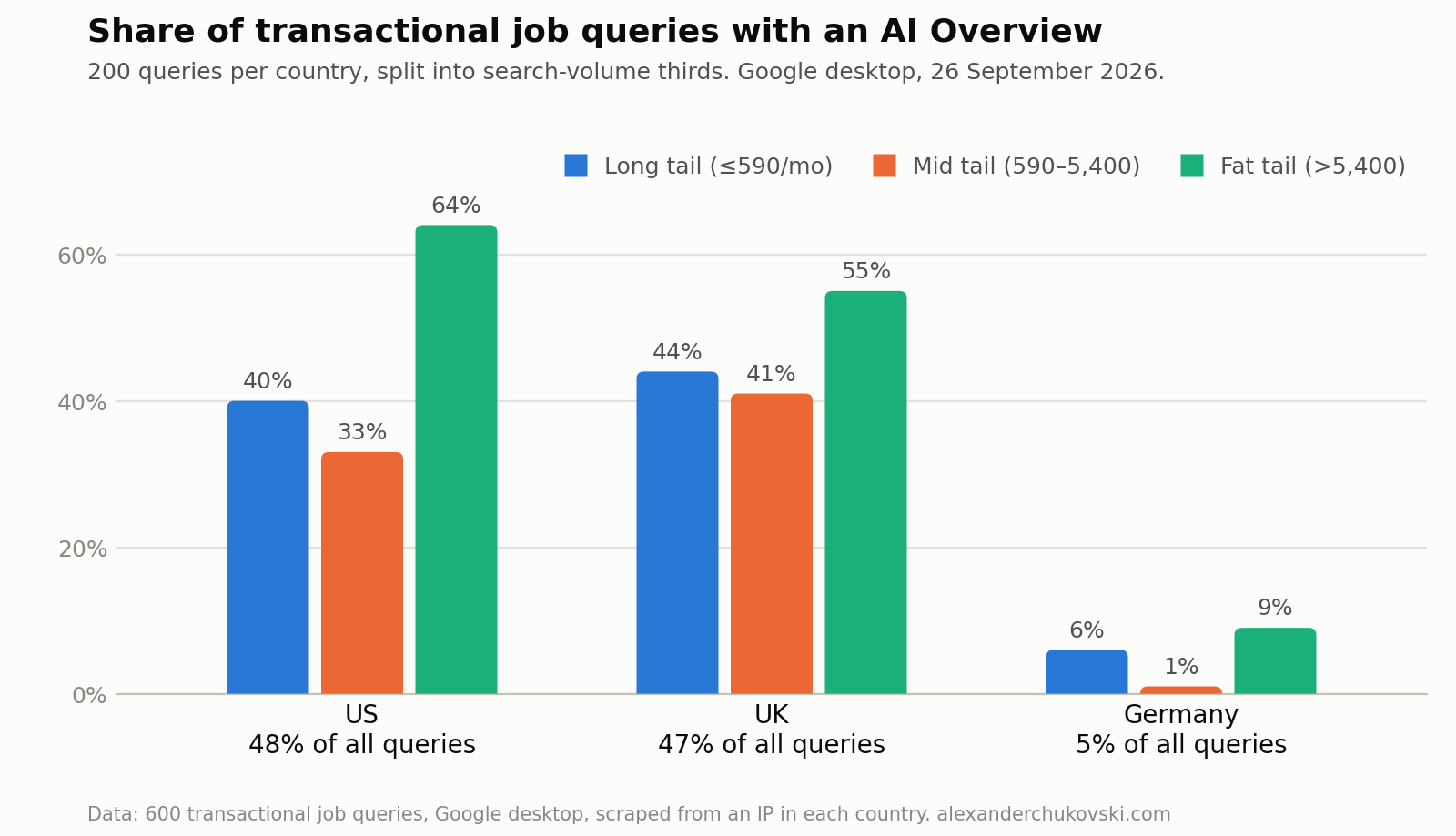
Fat-tail queries are about twice as likely to get an AI Overview. Below that, the curve is flat. Mid tail and long tail both sit at 25% across all countries, and in the US the long tail (40%) even beats the mid tail (33%). If you hoped your long-tail category pages were safe because Google does not bother with small queries, this data does not support it.
Does it hold? The second check
An AI Overview on one day tells you little if it is gone the next, so every query was checked twice.
| Country | Both checks | First only | Second only | Neither | Same result both times |
|---|---|---|---|---|---|
| US | 62 | 9 | 33 | 96 | 158/200 (79%) |
| UK | 51 | 9 | 43 | 97 | 148/200 (74%) |
| Germany | 7 | 6 | 3 | 184 | 191/200 (96%) |
| All | 120 | 24 | 79 | 377 | 497/600 (83%) |
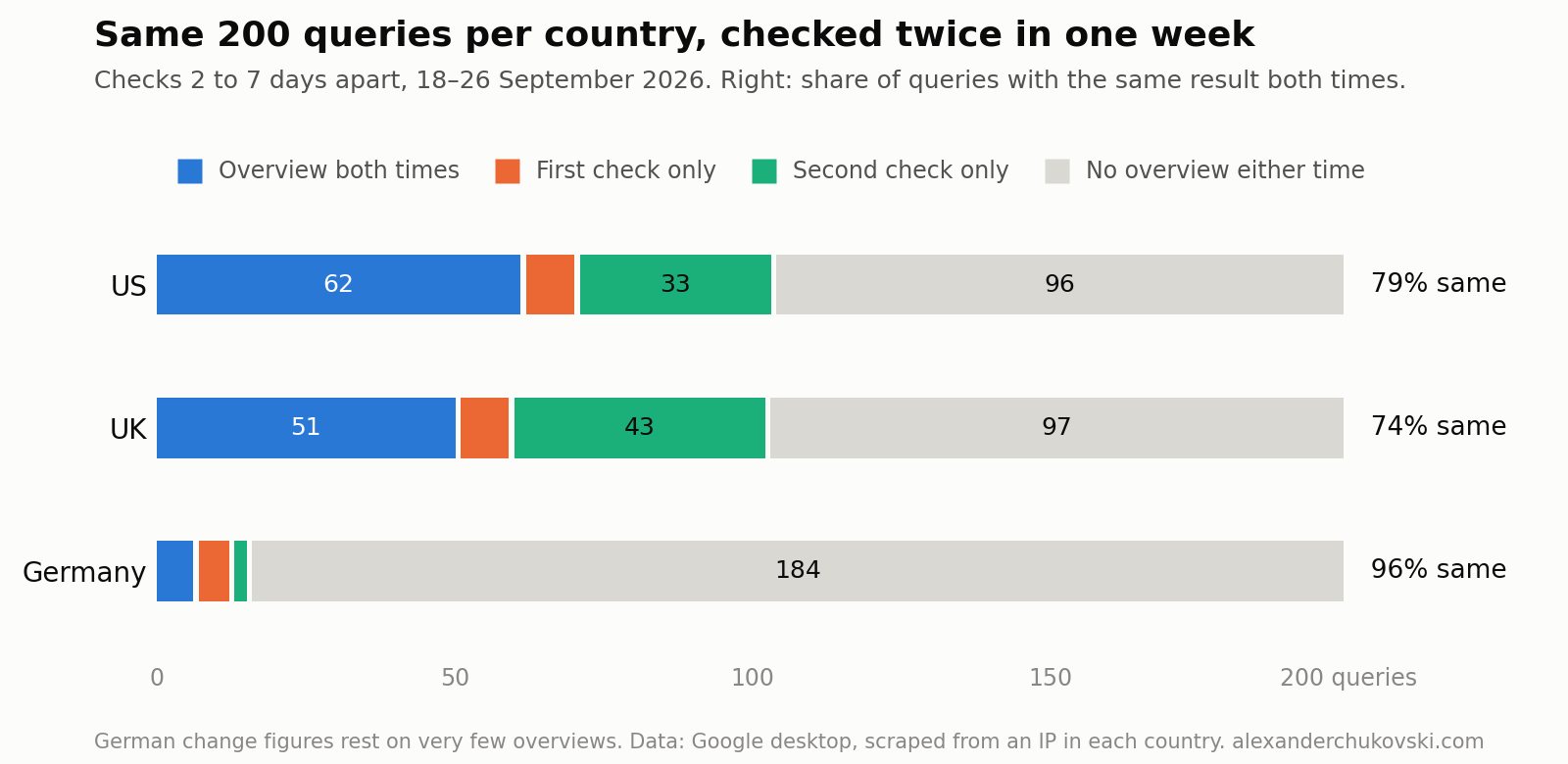
Read the last column carefully. Germany scores 96% not because German AI Overviews are stable compared to the US, but because they are almost always absent. Predicting "no AI Overview" in Germany is right nearly every time. The numbers that mean something are the US and the UK, where roughly a quarter of the queries changed state between the two checks (21% in the US, 26% in the UK).
So an AI Overview on a job search is not a fixture. For a big chunk of queries, it is closer to a coin flip. And the flips are not obscure searches. In the US, "marketing jobs" (1,000,000 searches a month), "night shift jobs" (550,000) and "construction jobs" (40,500) gained an AI Overview between the two checks, and so did "remote jobs" (90,500) and "weekend jobs" (33,100) in the UK. "Writing jobs" (1,220,000) and "government jobs" (550,000) in the US lost theirs. The search volume behind a single one of these flips is larger than the entire organic traffic of most sites.
Across all 600 queries, 79 gained an AI Overview between the checks and only 24 lost one, a ratio of 3.3 to 1. That looks like expansion, and it may well be. I would not bet on it yet, though. The two collections ran at different times of day (07:50 and 12:04 UTC), and a time-of-day effect would look exactly the same. A third collection at a matched hour will settle it.
What this data cannot say
I want to be precise about the limits, because they are what makes the rest credible. This is one collection method on one device: scraped Google result pages, desktop, one IP location per country. No mobile, no signed-in users, no city-level results, and AI Overview presence is known to vary with all three.
It is 600 queries in one vertical, transactional job search, and nothing here generalizes to shopping, health or informational queries.
The two checks were 2 to 7 days apart, not a fixed interval. The longer intervals turned out to be the more stable ones, so pooling them does not inflate the churn (if anything, it understates it). The German change figures rest on 7 AI Overviews, which is not enough for a finding. The expansion ratio is the weakest claim, for the time-of-day reason above. And two checks in one week measure short-term volatility, not a trend. Nothing here says what coverage will look like next month.
What AI Overviews do to clicks
Our data counts AI Overviews, not clicks. For clicks, the best we have are third-party studies, and they point in one direction.
Ahrefs compared 300,000 keywords using Search Console data and found that the CTR of the position 1 result drops by 58% when an AI Overview is present, up from the 34.5% they measured in April 2025. Pew Research tracked 68,879 real searches from 900 US adults: users who saw an AI summary clicked a traditional result in 8% of visits, against 15% without one, and clicked a link inside the summary in 1% of visits. In Germany, SISTRIX measured the position 1 CTR falling from 27% to 11% when an AI Overview is shown, about 265 million lost organic clicks per month.
Seer's study has the most useful split for us. On transactional queries with an AI Overview, the CTR of brands that were not cited fell 48% during 2025, from 4.17% to 2.15%. The CTR of cited brands more than doubled, from 0.7% to 1.7%.
Not all the data points the same way. Semrush looked at the same keywords before and after they started showing AI Overviews and found the zero-click rate went slightly down, from 33.75% to 31.53%. Seer saw organic CTR on AI Overview queries recover from 1.3% in December 2025 to 2.4% in February 2026. And Liz Reid, who runs Google Search, has argued that AI in Search drives more queries and higher quality clicks.
I take these seriously. But almost all of this data comes from informational queries, where the user often gets what they need from the summary and leaves. A job seeker cannot apply to a summary. So on a job search, I do not expect the clicks to disappear. I expect them to move and this is what both exciting and scary.
What part 2 covers
In part 2, I go through what the AI Overviews actually say and where they send people: which domains get cited, how the citations relate to the organic rankings, why Reddit and YouTube show up on searches where people want a vacancy, and what all of this means for job boards. One number to take with you until then: of the 120 queries that had an AI Overview at both checks, only 6 came back with identical text.