Why did Google stop approving Indexing API requests and quota increases?
For the past 9 to 10 months, Google has not approved a single Indexing API quota increase request. And, as quota increases are equal to new Indexing API onboarding, this means that no newly created job board received Indexing API privileges. At least not to my knowledge, and I have visibility over at least 50 different applications submitted in this period, some of them multiple times. Not one went through.
If you run a job board and you have been waiting since last fall for your approval, I have bad news: you are not doing anything wrong - it is a global problem.
Well, you could consider this good news, in a way - no one else is getting approved either.
So, why is this happening?
In the words of the great Chad Sowash and Joel Cheeseman - time for a hiiiistory lesson!
Let's look at the history of these freezes, because this is not the first time it has happened, and the past patterns tell us something about what might be coming.
A short history of Indexing API quota freezes
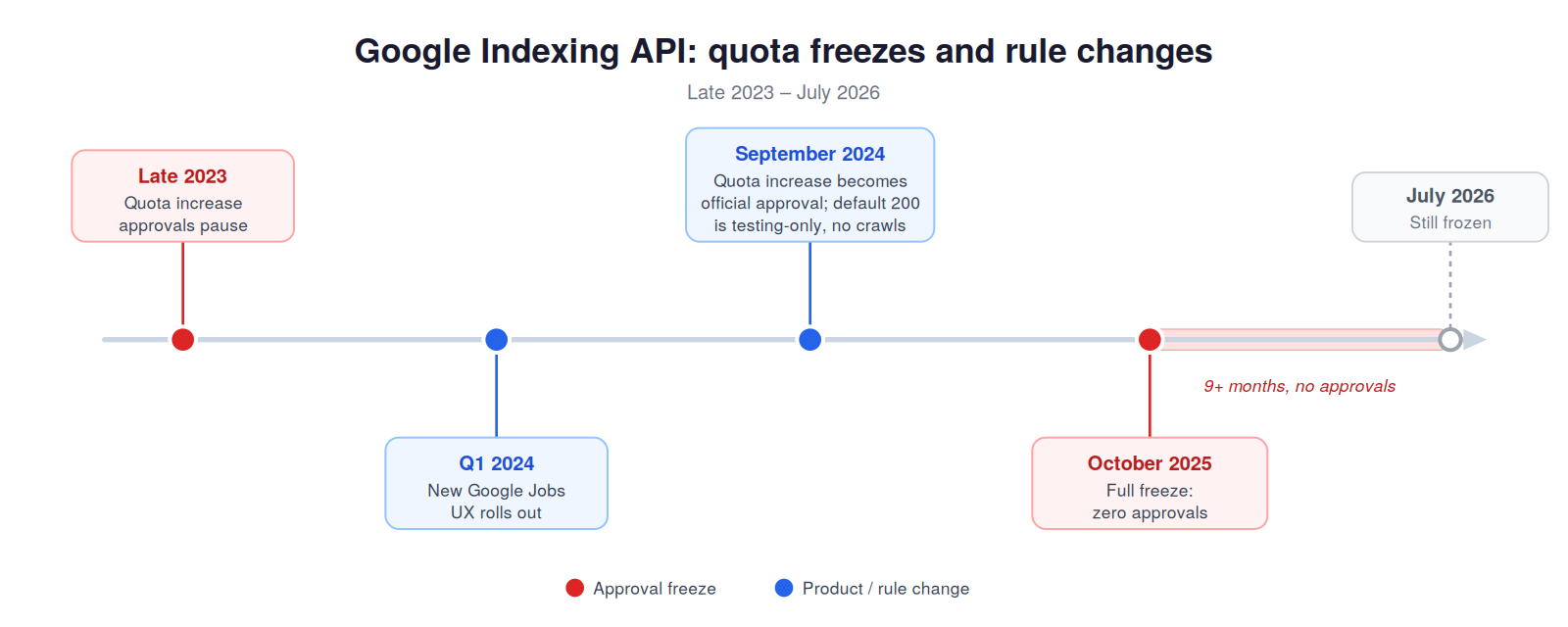
This is not new behavior. In late 2023, Google stopped approving quota increase requests for a while. Looking back, I am pretty confident this was connected to the new Google Jobs UX that rolled out in Q1 2024. Google was rebuilding the front end, and the last thing they needed was a flood of new senders pushing content into a system under reconstruction.
Then came 2024, where approvals more or less stopped again until the Indexing API rules changed in September 2024. I covered that change in detail in Major updates to the Indexing API - Impact on Job Boards and Aggregators, and Barry Schwartz covered it on Search Engine Roundtable. Here is the short version:
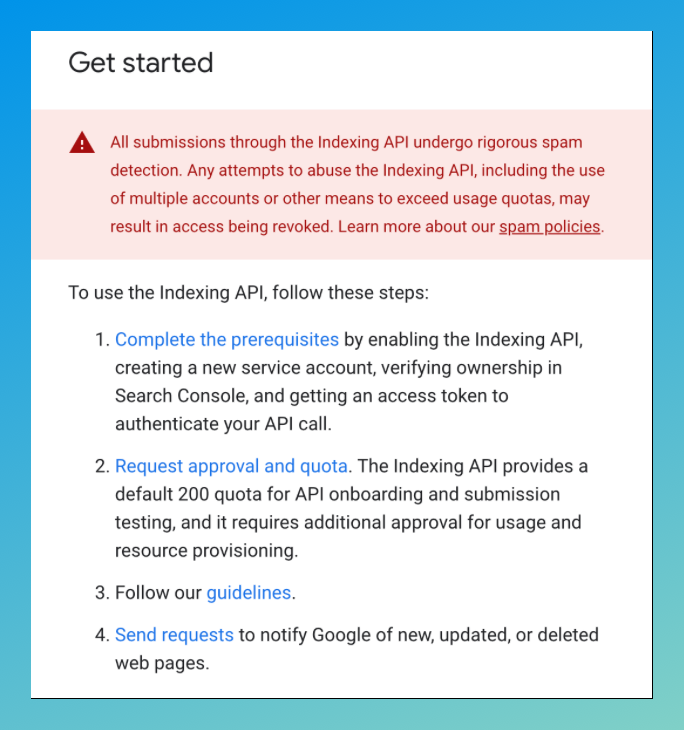
Since September 2024, the quota increase request also serves as official approval to use the Indexing API. The default 200 requests per day are for testing only — and here is the part most people miss — they don't even trigger a crawl request from Googlebot. You submit, you get a 200 OK response, and nothing happens. To actually use the API in production, you have to submit an increase request, and if it goes through, you are approved.
Google's documentation says this openly now, together with a rather aggressive spam warning right at the top of the "Get started" page:
2024 was also the year of the big Google Jobs spam cleanups. There were quite a few bad players pushing very spammy content to the Indexing API — fake jobs, expanded jobs, expired jobs, SERP redirects — often abusing subdomains to multiply their quotas. The September 2024 approval requirement was Google's answer to exactly this.
At least, this is the only explanation that makes sense to me.
The current freeze: October 2025 until today
And now we are in freeze number three, the longest one yet. Since October 2025, approvals for quota increases have stopped completely.
This is not just my client base. Nick LeRoy, who runs SEOJobs and PPCJobs, asked John Mueller directly on Bluesky in May: Are there any known issues with the quota request form?
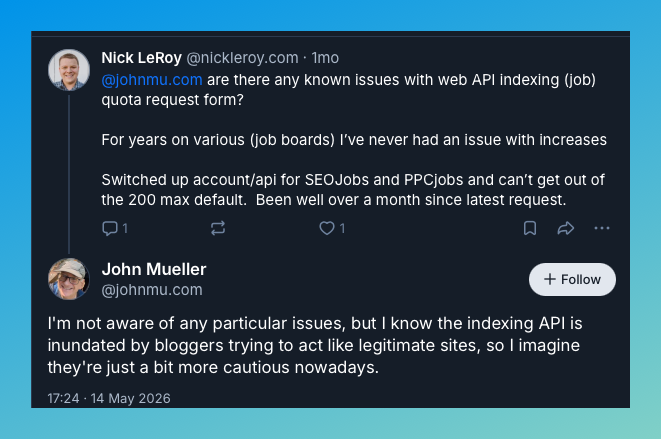
Mueller's answer is worth reading closely. He is not aware of any particular issues, but he knows the Indexing API is "inundated by bloggers trying to act like legitimate sites," so he imagines Google is just more cautious nowadays.
So, to translate this - Google's official position is that nothing is broken - Google is simply choosing not to approve. And the reality on the ground matches: no one gets approved. Not new job boards, not established operators like Nick asking for higher limits, not anyone.
If you are a new job board launching today, this effectively means you cannot get your jobs into Google Jobs quickly. You are back to sitemaps and hoping Googlebot shows up.
Why is this happening? Two theories
I don't have inside information here, so treat this as informed speculation. But I have been doing Google Jobs optimization for job boards for almost 8 years now and I have seen a lot.
So, allow me to propose two explanations that fit the evidence.
Theory 1: The indexing tool abuse got out of hand
2024-2025 saw a huge increase in "indexing API tools" promising quick indexation for non-job content. As you probably know, the Indexing API can only be used for jobs and live video — never for other content. I wrote about this back when the advice started circulating on SEO Twitter in Is it OK to use the Indexing API for non-jobs?, and I have said it multiple times on LinkedIn since: yes, non-job content submitted through the API will get indexed, but just for a short time.
That is exactly why the tools sell.
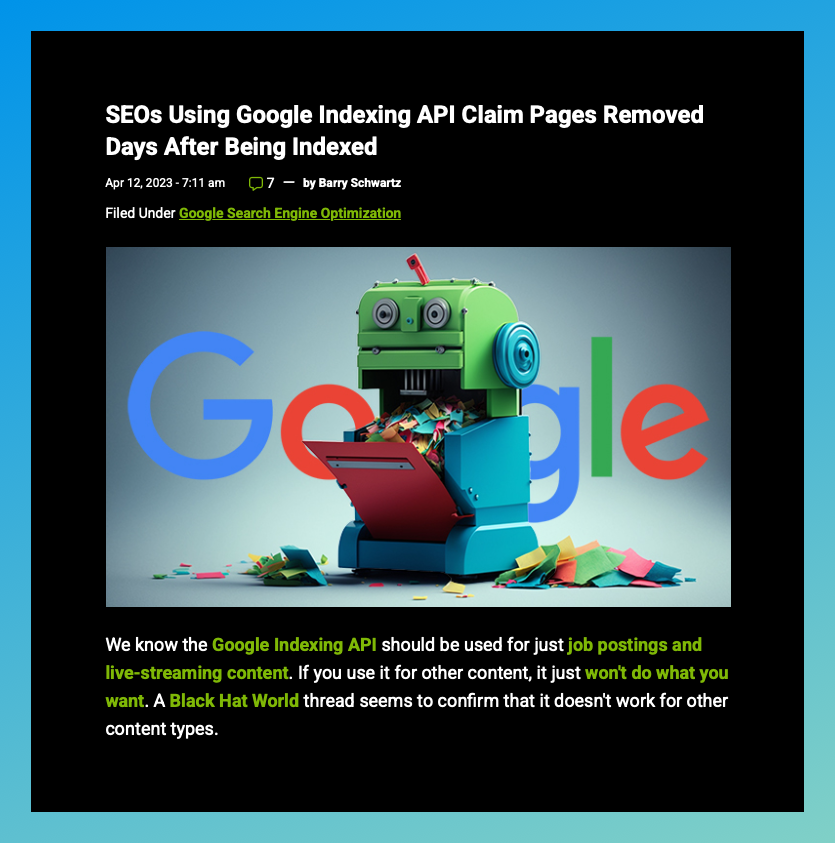
But it doesn't end well —Barry Schwartz confirmed as far back as April 2023 that SEOs using the Indexing API for regular content saw their pages removed from the index days after being indexed.
That did not stop anyone. A whole sleazy industry of "indexing services" was built on rotating service accounts and pushing blog posts, e-commerce pages and worse through an API meant for job postings. Mueller addressed this directly in May 2025 — his recommendation was to stick to the documented and supported use cases, and the phrasing left little room for interpretation: use it properly, or don't use it at all.
Notice how this connects to his answer to Nick a year later. In 2025, Mueller was warning spammers. In 2026, he explains that “they” (presumably the people who approve the requests) are much more careful in the approval process.
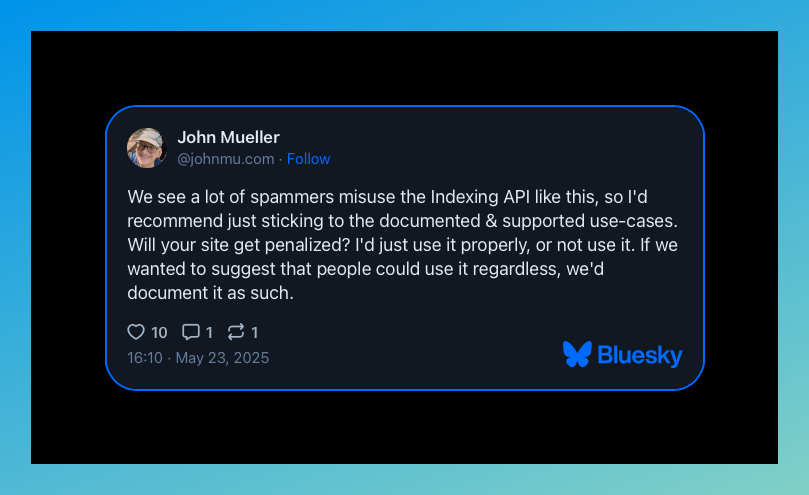
Well, being careful is not the same as not doing something to avoid risk but it offers a simple explanation.
If you are Google and you see the approval pipeline being gamed at scale by indexing services, the cheapest fix is to stop approving anyone until you figure out a better vetting process. Collateral damage: every legitimate job board waiting in the queue, like Nick's and my clients, some of them running 20-year-old, high-quality domains that get decent organic traffic and millions of organic visitors, suffers in the meantime.
Theory 2: Google is cleaning up Google Jobs for Gemini
The second theory is more strategic. Maybe Google is cleaning up Google Jobs and preparing it for integration into Gemini. That would absolutely make sense — if Gemini is going to answer "find me remote data engineer jobs" queries, Google needs a job index it can trust, and freezing the current one until a more legitimate way to handle Indexing API requests is created makes sense.
What supports this theory: I have seen a rather weird increase in manual actions for expired jobs and spammy content on a couple of properties recently — and these manual actions are not going away. Google is actively enforcing quality on the existing corpus while keeping the door closed for new senders. That looks a lot like someone preparing a dataset for a new product, not someone maintaining a legacy feature.
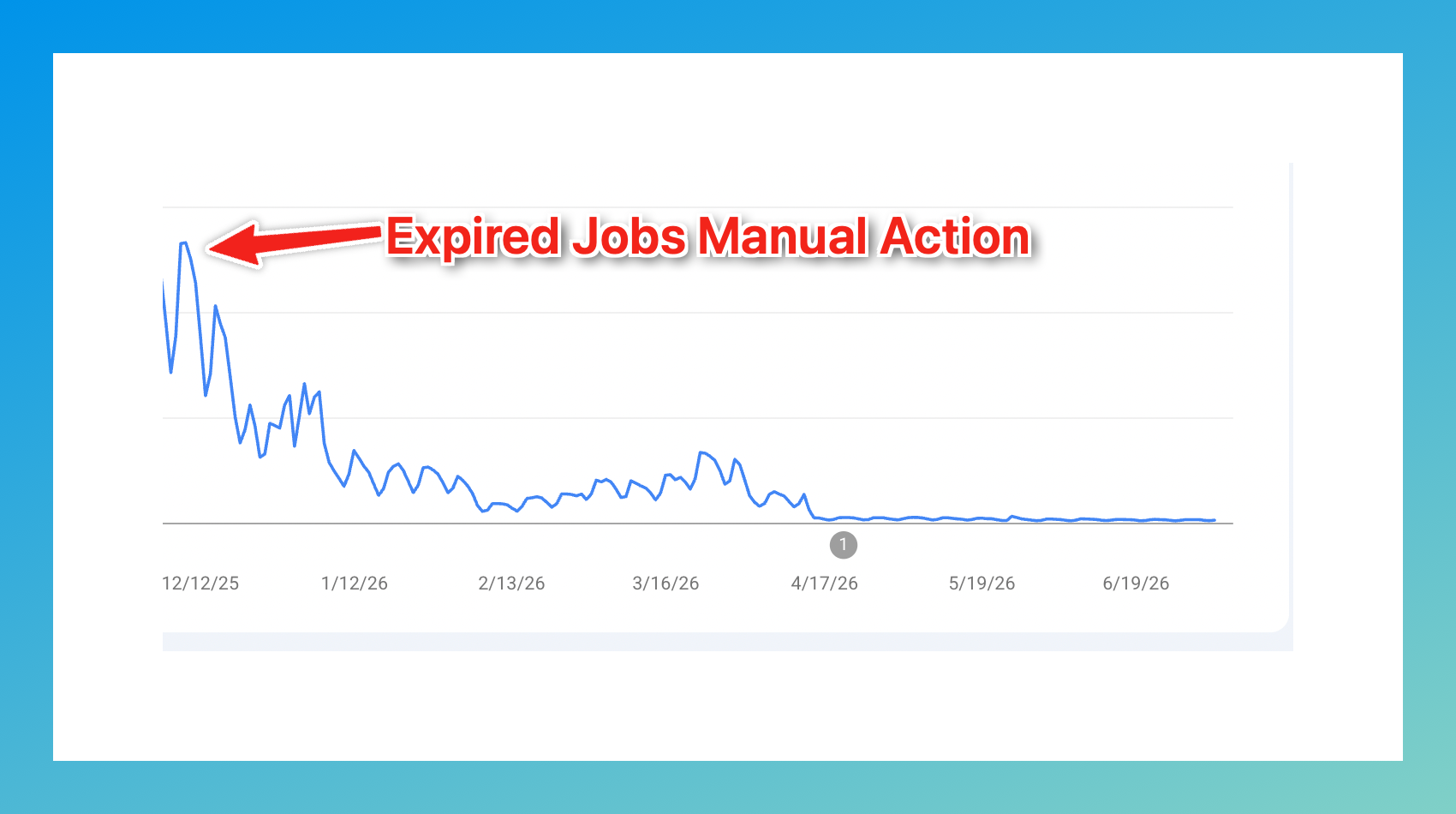
So much on any speculations about whether Google Jobs is going away - I think not.
I have written before about the bigger question of where Google Jobs is heading in The Uncertain Future of Google Jobs: What 2025 Holds?, and this freeze fits the pattern: Google is not abandoning the product, it is tightening control over it.
The Indexing API is not the only way into Google Jobs
One thing to keep in mind: even though the Indexing API isn't working right now, that doesn't mean you cannot get your jobs indexed.
The Indexing API is a nice shortcut, not a requirement. A well-structured and optimized job board will usually get between 10-15 of its traffic from Google Jobs alone; a major chunk comes from the category pages. How?
Google discovered and indexed job postings long before this API existed, and it still does. A well-crawlable site with a good structure and proper, clean JobPosting markup will help Google discover your jobs outside of the Indexing API — sitemaps, solid internal linking, fast page loads, and valid schema still get you into Google Jobs. It just takes longer and requires a good taxonomy.
So if you are stuck in the approval queue, focus on making your site trivially easy to crawl. When the freeze eventually lifts, you will also have a cleaner property to show Google — and document quality is exactly what decides who gets approved.
If you need help with improving the technical SEO of your job board or building a job taxonomy that optimizes your site crawlability, reach out!