AI Is Killing the Unified API Connector Business in HR Tech

Things look slightly dark for the unified API connectors in our industry unless they build a new moat.
The unified API connector business in the online recruiting world had a simple pitch: why build 50 integrations yourself when you can use one API to connect to all of them?
It made sense. And for a while, it was a very good business. It just takes so much of the pain away – first, because it reduces the workload (1 vs N integrations) and second, because the ATS APIs were messy, old or practically behind a real walled garden. You needed someone to “let you in”.
But the first two core value propositions - that building integrations is hard and expensive -are rapidly falling apart. So is the part about open documentation and API quality.
Before I explain why, let me cover what these companies actually do, because this pattern extends well beyond HR Tech.
What are ATS connectors and unified APIs?
If you are a job board, a staffing platform, or any HR Tech company that needs to exchange data with an Applicant Tracking System (ATS), you have a problem. There are hundreds of ATS platforms out there, each with its own API, data model, and quirks. In the US alone, there are about 200 used ATS platforms. Germany has about 80 or so.
Some of you might say that this should not be a big problem after all, as probably a large number of jobs are covered by 2-3 ATS vendors, as is normal in other software markets. Well, think again. I would say that in the US, we are talking about 80.
I covered this topic extensively in my Introduction to ATS Integrations for Job Boards series. The short version: a job board can integrate with an ATS to pull jobs, get the application schema, submit applications, create candidate profiles and track their status. Getting the jobs is easy. The hard parts are pulling the application requirements and submitting an application that matches exactly what the recruiter configured in the ATS.
Unified API connectors like Merge, Knit, Unified.to, and Nango positioned themselves as the middleware layer that solves this. Instead of building and maintaining 50 individual integrations to Workday, Greenhouse, Lever, BrassRing and the rest, you build one integration to their unified API, and they handle the connection to all the underlying systems.
The value proposition was clear: save engineering time, reduce maintenance burden, ship integrations faster.
Back in 2017, I took on the role of product lead at another company with a similar but slightly different value proposition – JobSync. We worked primarily with employers as a service provider so that their candidates could apply natively on various job boards, and thus we increased the number of applications for hard-to-fill roles in retail, sales, and healthcare.
There are also RPA-based vendors that took a different approach, automating interactions with ATS platforms by scripting browser actions. As I wrote in Part 2 of the ATS integration series, these vendors are incentivized by driving application numbers up, not quality. But that is a different discussion.
Still, it is important to mention them so that we have a full context.
The original moat: integration complexity and access
The reason these businesses existed was simple. Writing an integration to an ATS took weeks. You had to dig through vendor docs (if any existed), figure out custom field mappings, handle pagination, deal with authentication flows, and manage painful edge cases involving data types and required fields. Don’t forget the updates and changes you need to monitor, too.
Often, ATS platforms did not want to deal with a single vendor, so going through a middleware provider was your only option.
Paying a middleware provider $500 – $2,000/month to handle that was a no-brainer for most companies. The integration itself was the hard part, and outsourcing it saved real engineering time.
And along comes AI
Well, that was before AI could write the same integration in an hour.
I have tried it myself. Give Claude or Codex the links to the API docs of any modern ATS, describe your data model or a JSON output sample, and you have a working integration by midday. Field mapping, error handling, and pagination - all done with minimal supervision.
AI coding tools got really good at handling these types of tasks.
So what exactly is the value of a third-party connector when the integration itself is no longer the hard part?
This is not theoretical. Any competent developer with access to an AI coding assistant can now do in an afternoon what used to justify a middleware subscription. The cost of building integrations has collapsed.
But what about maintenance?
The traditional counterargument goes like this: APIs change, new endpoints get added, and authentication flows get updated. Someone has to maintain these integrations over time, and that is where the connector vendors earn their keep.
Fair enough. But if AI can build the integration in an hour, it can also update it in 15 minutes when something breaks. Not only that, but Claude Code can build extensive tests and monitors on a running integration.
Now, can a vibe coder do an end-to-end ATS integration, deploy it to production, and have proper monitors with automated fixes? I doubt it. But a senior engineer – for sure.
From my perspective, the maintenance moat is evaporating just as fast as the build moat.
So, what is left?
The non-technical moats are real, but shrinking
Now, I want to be honest here. The argument above deliberately simplifies a few things, and some of these deserve attention.
There are real barriers that AI does not solve today. Many ATS platforms have terrible documentation, or no public documentation at all. Some require relationship-based onboarding - you literally need to know the right person at the ATS vendor to get API access.
Legacy systems like older versions of Taleo or Successfactors have APIs that are, to put it politely, not developer-friendly.
AI does not fix the politics of getting onboarded. It does not fix the lack of public docs for a 15-year-old enterprise ATS, and it will absolutely not fix cases where the ATS does not want to deal with 100s of niche sites and small vendors who want access to its APIs.
The business of an ATS is NOT to offer an API – it is to help recruiters hire candidates. Never forget that when you are dealing with an ATS.
But here is the thing: the industry is moving towards more open APIs and standardized protocols. MCP (Model Context Protocol) is pushing towards a world where AI agents can discover and interact with APIs more autonomously. The direction is clear, even if we are not fully there yet.
Some older ATS platforms have released new APIs that are well-documented and comparable to those of newer ATS platforms.
These non-technical moats are real today. In two years? I am not so sure.
The smart pivots: Merge and JobSync
To be fair, some of these companies already see the writing on the wall.
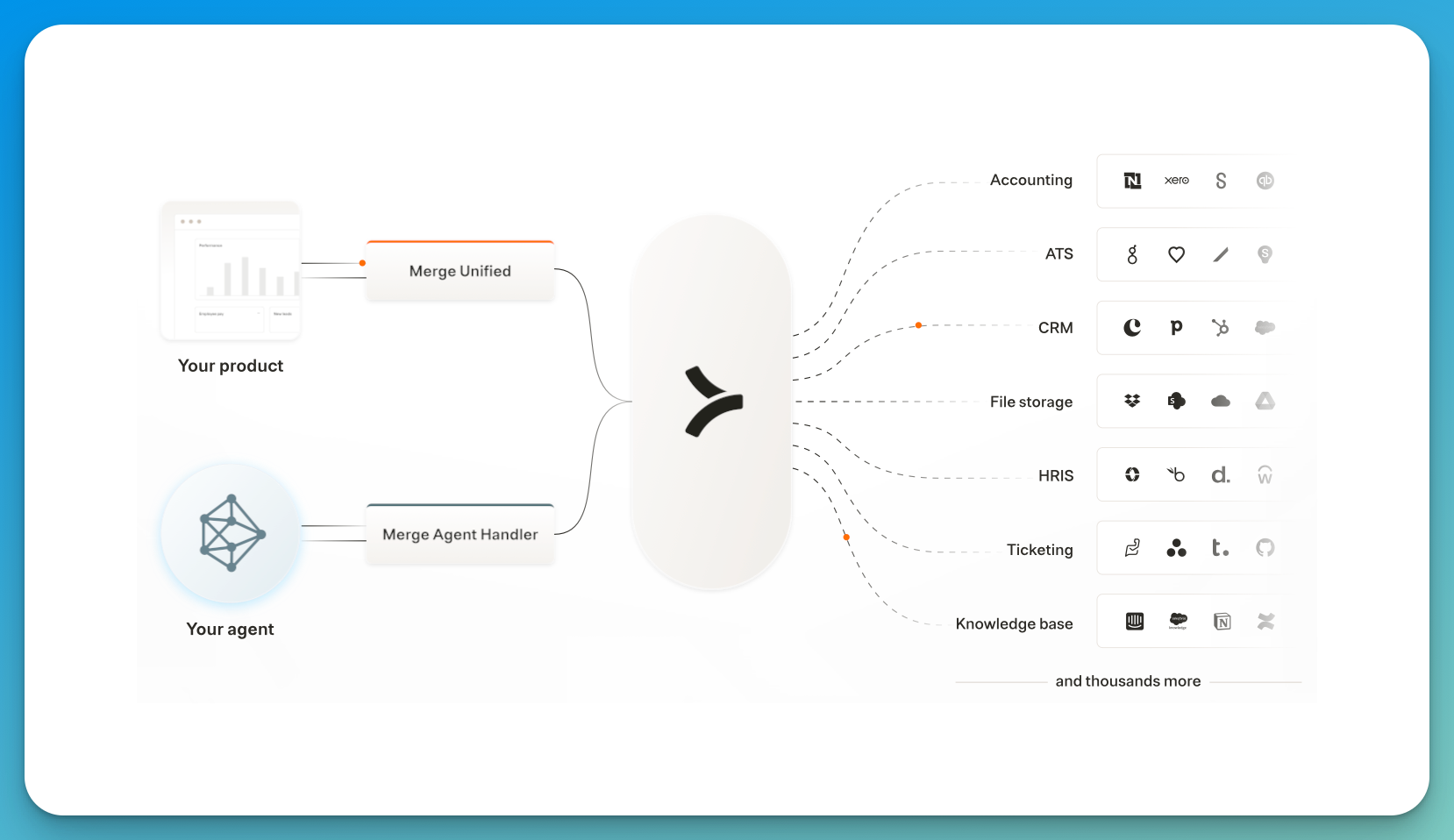
Merge figured this out. They stopped leading with unified APIs and pivoted into integration observability, agent tooling, and MCP connectors for AI agents. Their homepage now pitches itself as a provider of "agentic tools" for frontier LLMs and enterprise companies. They are listing OpenAI and Perplexity as customers. They have a product called "Agent Handler" that connects AI agents to thousands of third-party tools. They are selling picks and shovels for the AI gold rush instead of waiting to get buried by it.
Then there is JobSync, where I worked for a year back in the pre-gen-AI days alongside Alex Murphy.
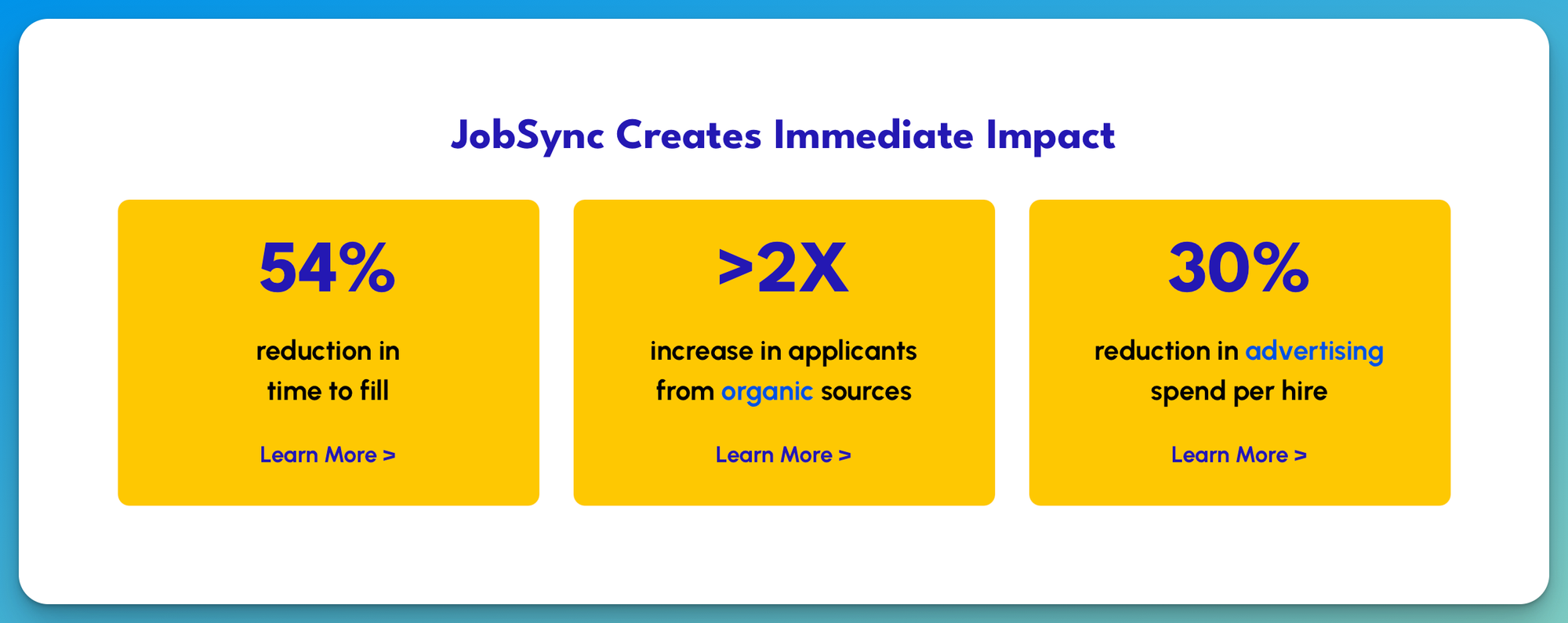
JobSync took a completely different path. Instead of staying a connector, they built an end-to-end hiring operations platform. Their pitch today is about cutting time-to-hire by over 50%, optimizing ad spend, and right-sizing applicant volume for hard-to-fill roles. The ATS connections are infrastructure, not the value proposition. They have a job manager, a career site product, and native apply - the integration is just the plumbing underneath.
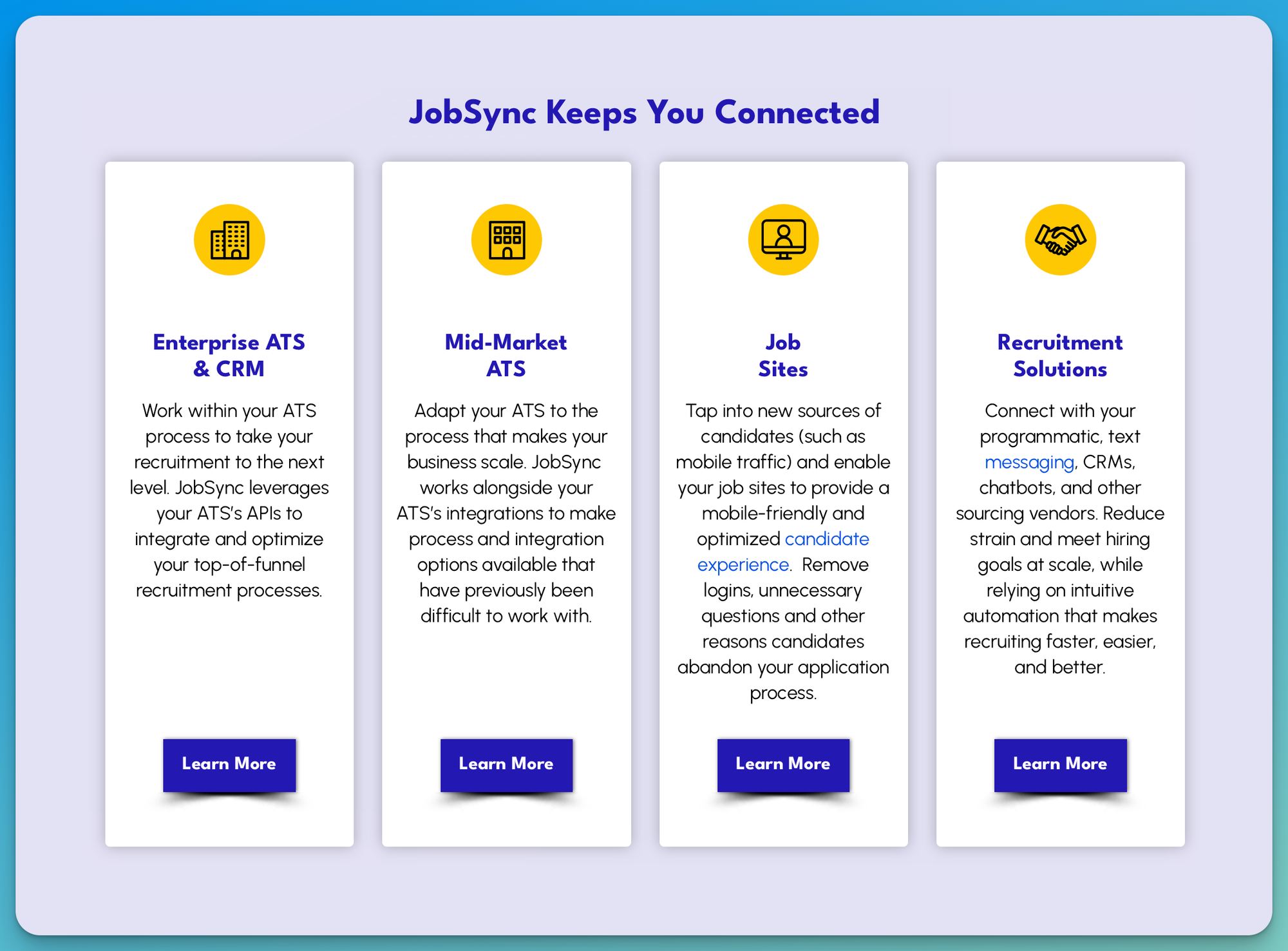
This is the right approach, and both companies deserve credit for this.
What this means for the rest of the connector market
Well, the market grew quite a lot over the past 4 years, and there are plenty of vendors, which, for me, was always a sign that the market is still not saturated.
So, what is next for them?
The ones still selling "we connect to 200+ systems" as their core value prop should be worried. Bragging about having 200 integrations is a bit like bragging about having a PC for each one of your employees. It used to be impressive in the 90s, now it is a given.
This is actually an interesting pattern of how AI changes a business. The old software layer does not disappear - it becomes basic infrastructure. AI creates a new value layer on top of it. The companies that recognized this early (Merge pivoting to agent tooling, JobSync building a complete hiring platform) are the ones that will survive.
The ones still charging middleware fees for something a developer can now build in an afternoon with Claude? That pitch has an expiration date.
If you are evaluating an ATS connector vendor today, ask yourself: what am I paying for? If the answer is "they connect us to ATS platforms," that is no longer a $2000/month answer. If the answer is "they give us hiring intelligence, observability, and workflow automation on top of the connections," that is a different conversation.
Disclaimer:
I am not associated with Merge or Jobsync and I am not advertising their services – always dyor.