ChatGPT will not become the next big job search channel.

Hard to believe, but today, you can search and apply for a job on ChatGPT thanks to a couple of companies that launched job-search apps. And somehow, this hasn’t gained any traction in the job board/HR Tech community, and I am willing to bet that in a few months, it won't change much.
Yeah, that is a big bet, so let me explain.
We have seen this movie before
If you were in online recruiting in 2016–2017, you probably remember how scared everyone was about Google’s entry into our space. People were freaking out. I remember the conferences in this period — everyone was trying to talk to the Google folks who showed up, trying to figure out what was about to happen.
Just a few years later, Google quietly exited online recruiting. They closed the ATS, the matching product is more or less dead, and Google Job Ads was killed before launch.
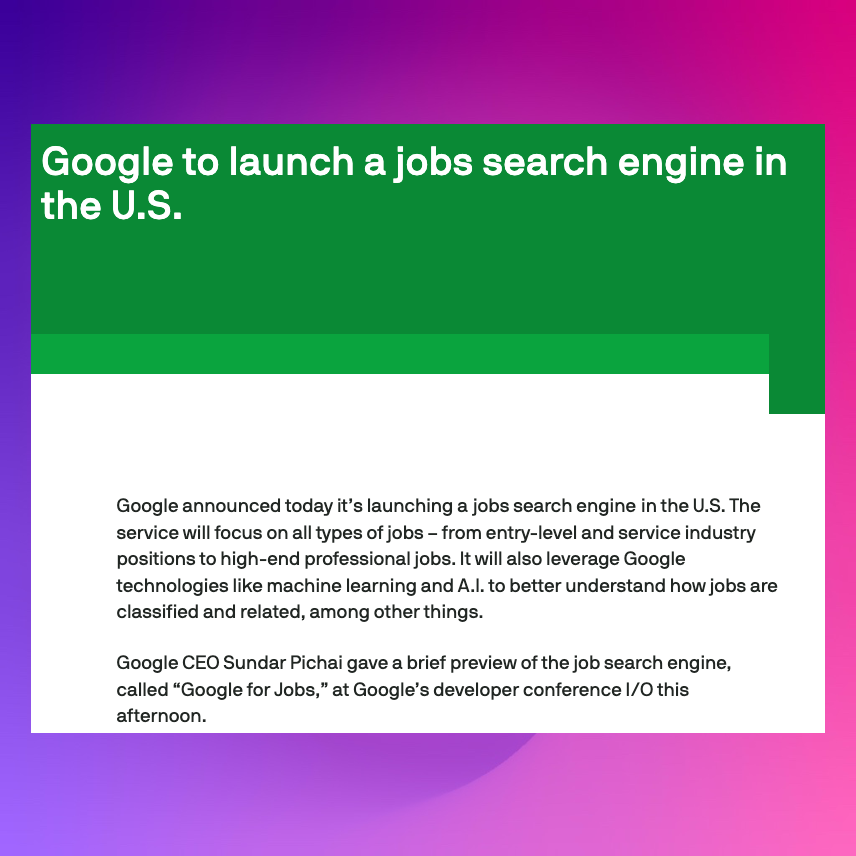
Their matching product was actually superior back then — far better than what any vendor in the space (Sovren, Textkernel) offered. So why did it fail? The problem was that it was very technical, and most job boards were not technical enough to implement it.
I am bringing this up because I see the same dynamic playing out now with ChatGPT and Claude. There is a panic forming around the edges of the industry, a fear that LLMs are about to eat job search. And there is some truth in there — but the mechanics matter, and the mechanics are why this isn’t going to play out the way the loudest LinkedIn voices think it will.
What you can actually build on ChatGPT today
To be clear, the technology is real. Today, you can build an app on ChatGPT that serves jobs pulled via API from your database. ChatGPT Apps and Claude Connectors are real surfaces, and OpenAI and Anthropic are pushing them.
Right now, I am aware of 5 apps in ChatGPT that serve as job boards, and SonicJobs has been an absolute pioneer here, so I have to give them credit. Mikhil and the team have been following this vision for a while, and they have a unique edge over the others. They have also built genuinely impressive technology under the hood, which I will get into in a moment. But more on this in a second.
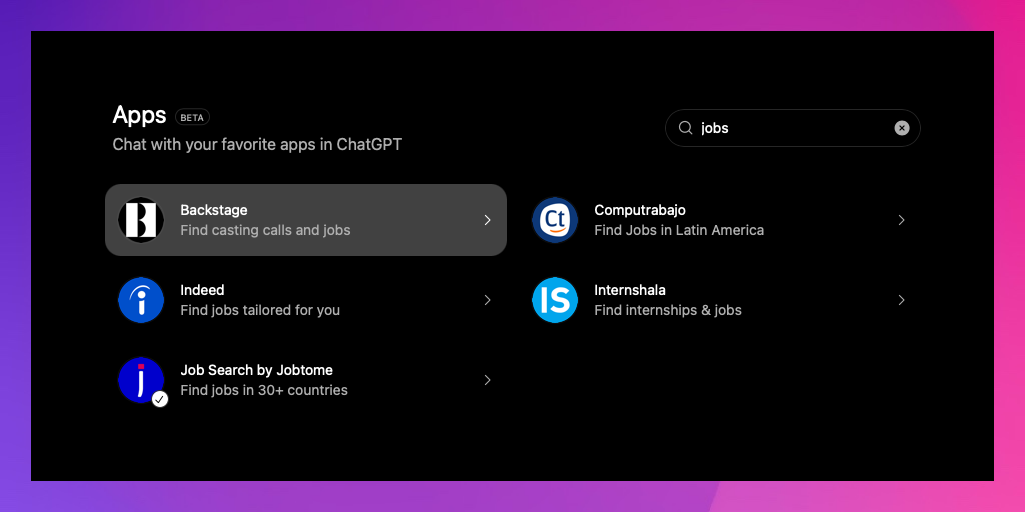
The flow goes something like this:
First, a job seeker has to find your app in the apps menu list:
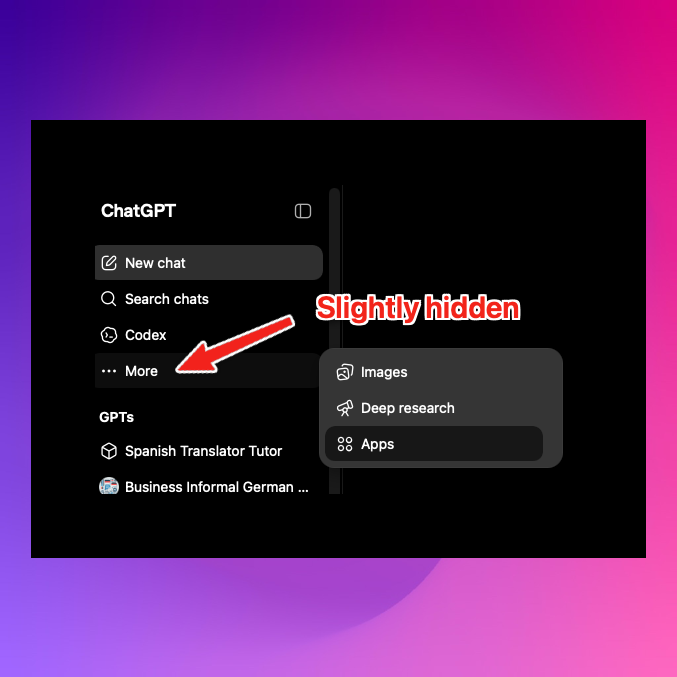
Then, as I said, users need to find it:
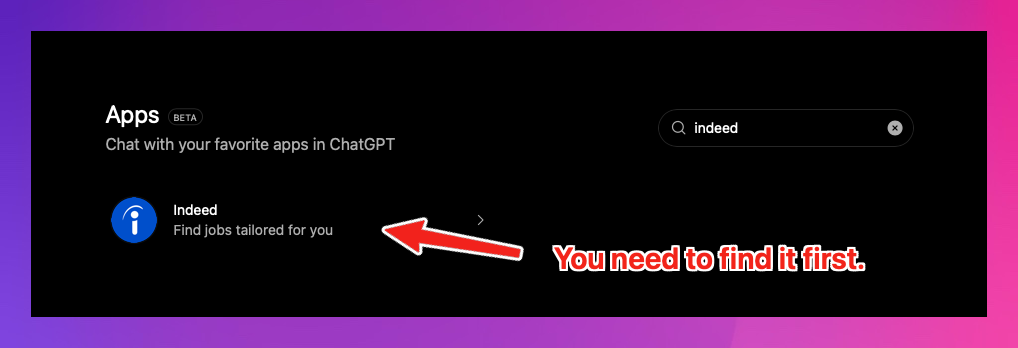
Second, they have to install it in their ChatGPT:
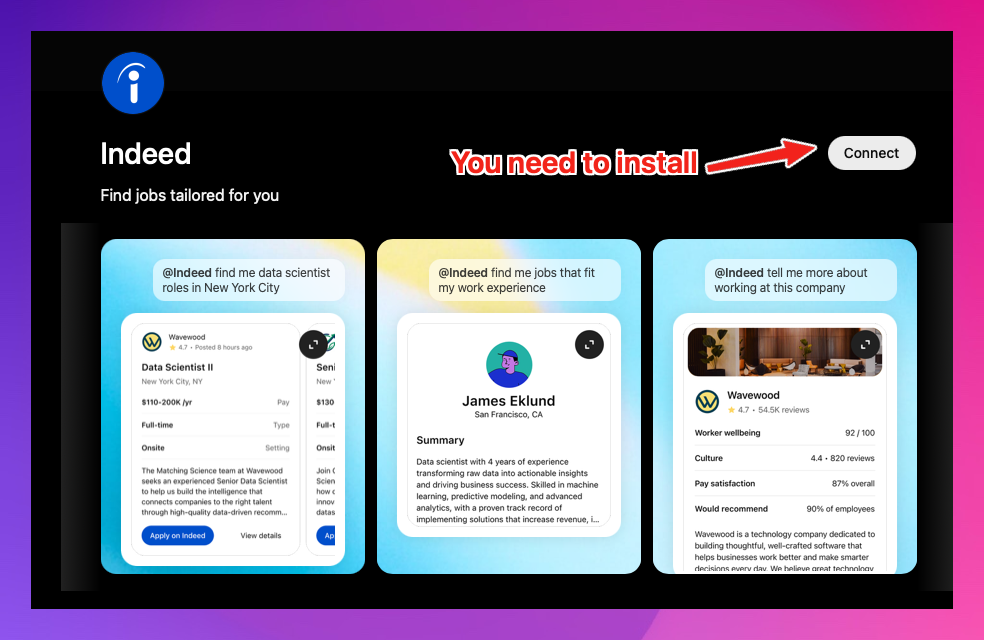
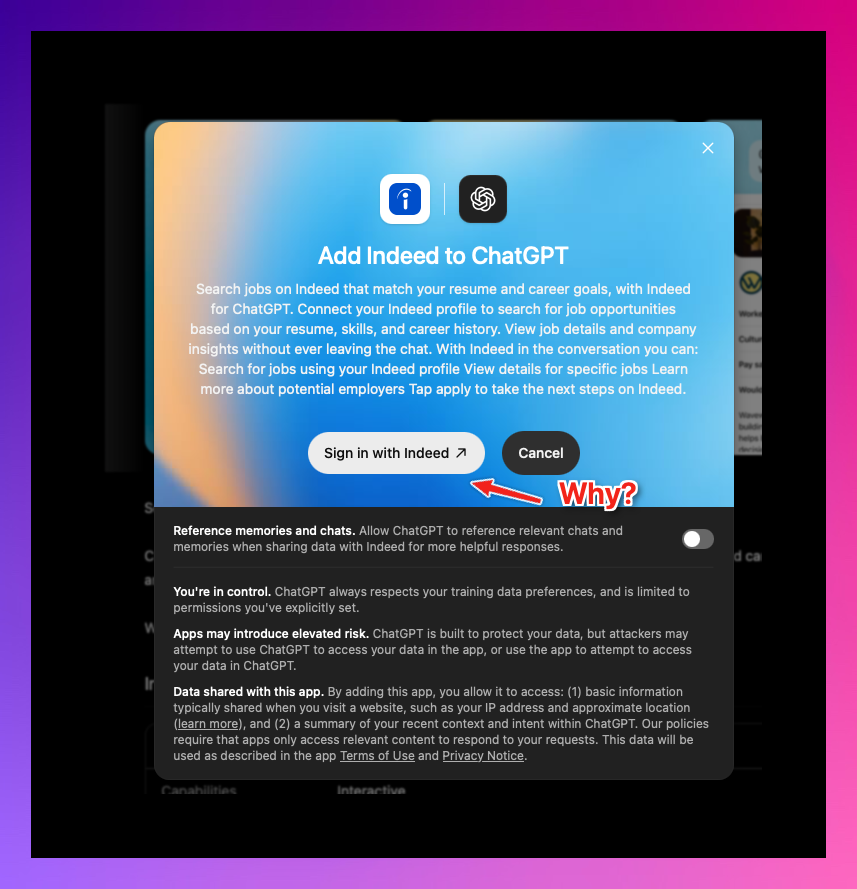
In Indeed’s case, you also have to log in to do that, and if you don’t have an account, you need to go through the usual Indeed shenanigans (provide a phone number and verify it).
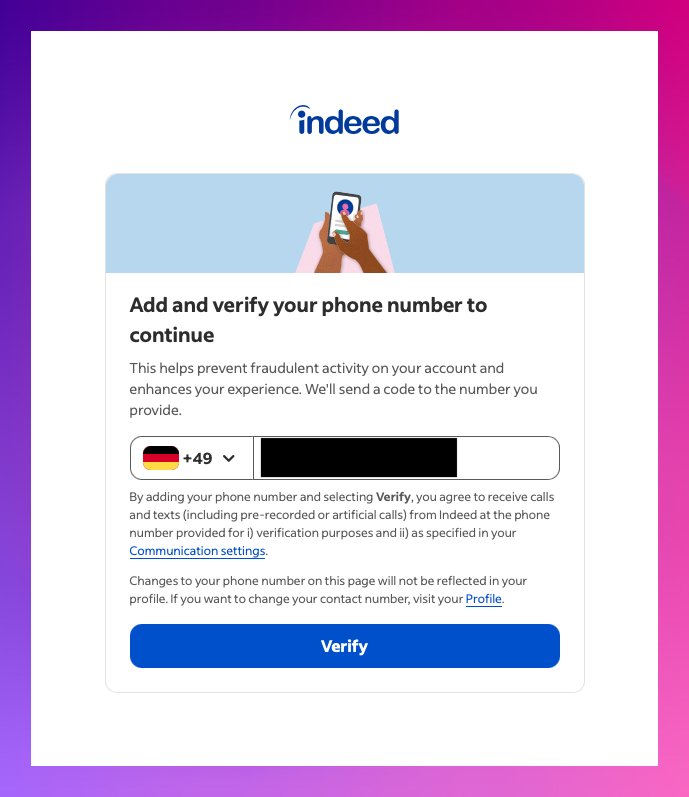
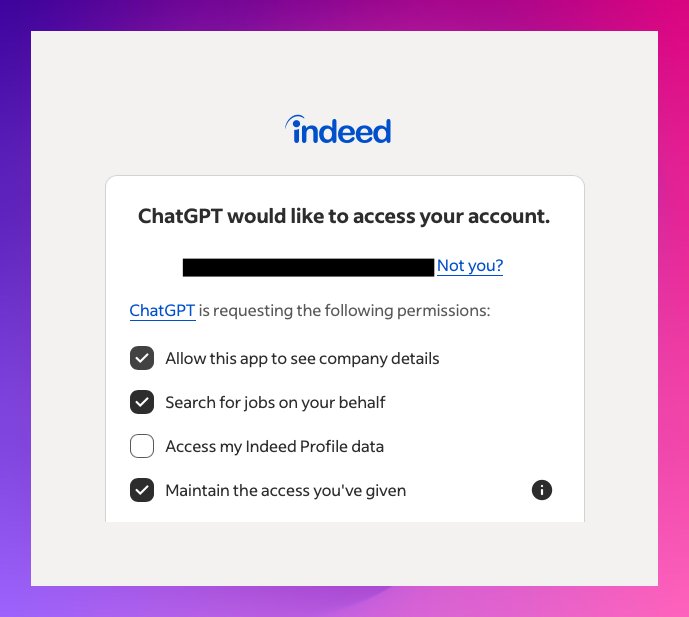
Once this is finally done, if you want to use the app, you have to tag it to activate it within the ChatGPT experience. Once it is activated, the user can search jobs via chat, see results and then … get clicked out to the job board. Does this seem familiar?
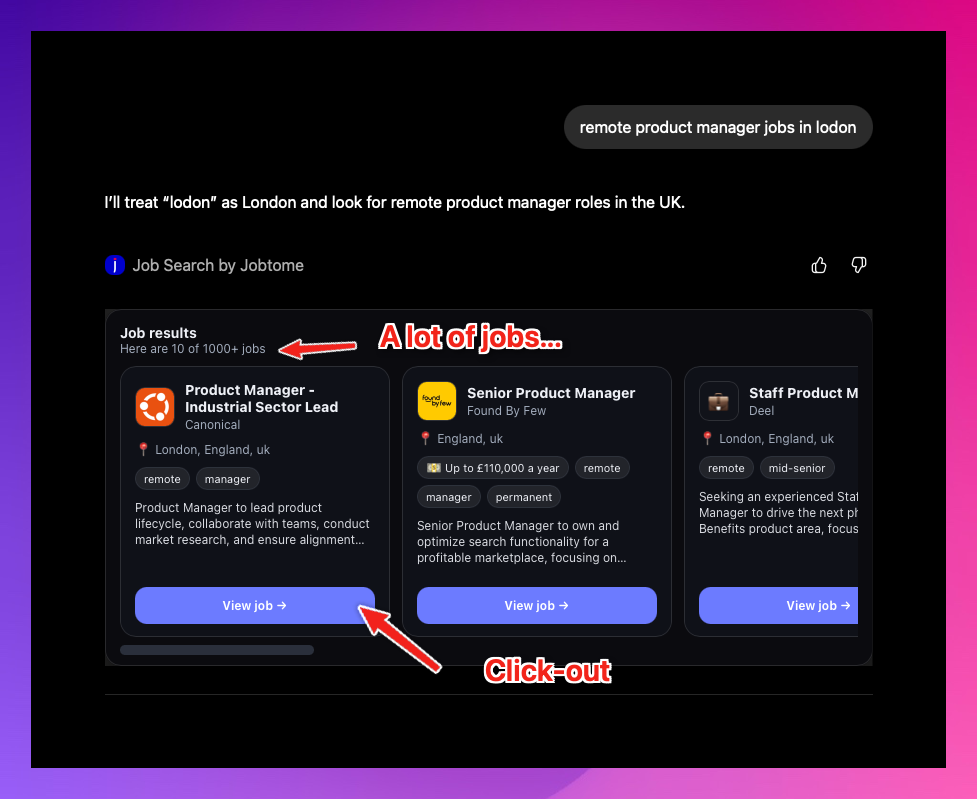
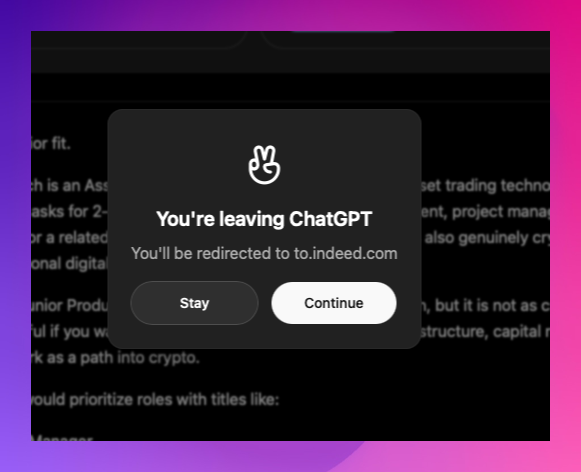
It probably does, because this is what we have today with Google Jobs and pretty much any job aggregator user experience. A click-out… so sad.
What if you want to apply for a job in the ChatGPT UX?
This gets a bit more complex because the application delivery is not easy (I have covered this in the past here and here). You can only do it as a job board if you are deeply integrated with the ATS of the employers you work with, and you can submit applications via the API. This is what Indeed has, which is a unique value proposition, but has not been enabled yet (I wonder why).
There is another way — you can still try to push applications through using a headless browser and LLM-powered automation, the same way RPA-based apply tools have done it for years (I covered the mechanics of this in a recent webinar with Oras, and Jobcopilot is also able to do that).
In this case, you capture the application in ChatGPT, push it via the app’s API to your backend, and deliver it to the user.
This is what SonicJobs does, although they have developed proprietary technology I don’t know much about beyond what is publicly available — but apparently they cover a wide range of ATS without end-to-end integration. That is a hard engineering problem, and they have solved it at a scale that very few in the space have matched.
Now this is a major differentiation. It is also genuinely very good work, and worth saying out loud.
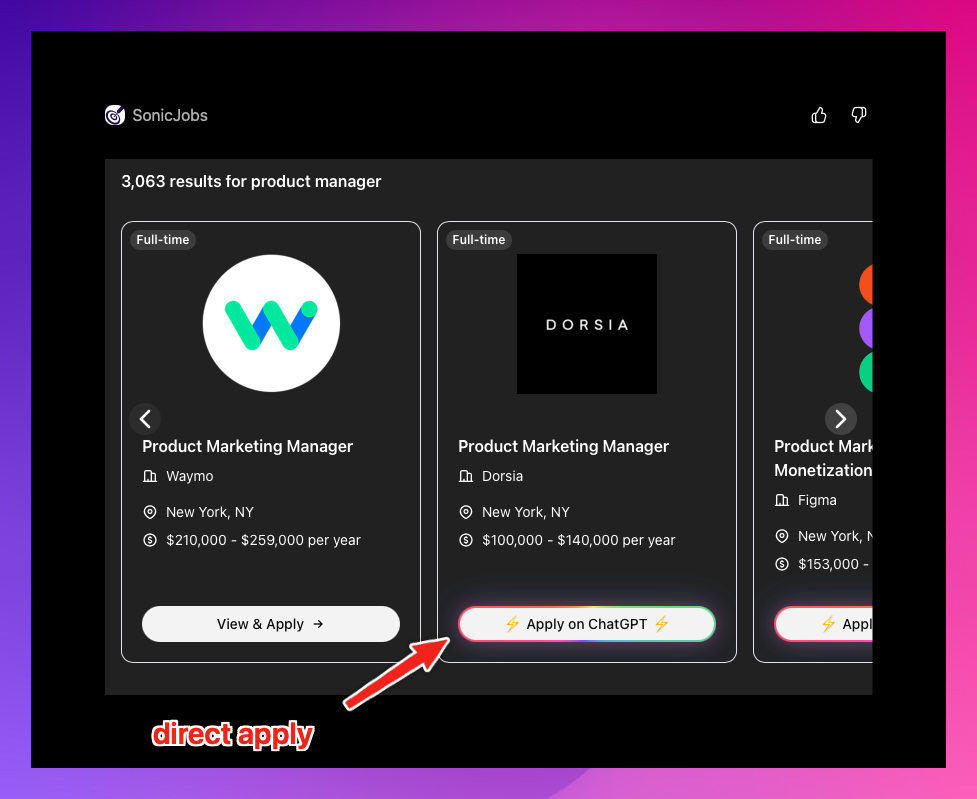
The application itself can be augmented — ChatGPT can write a customized CV and cover letter for the role on the fly. The whole thing happens without the user ever leaving the chat.
Here is what the SonicJobs direct-apply flow looks like end-to-end — and it is clean:
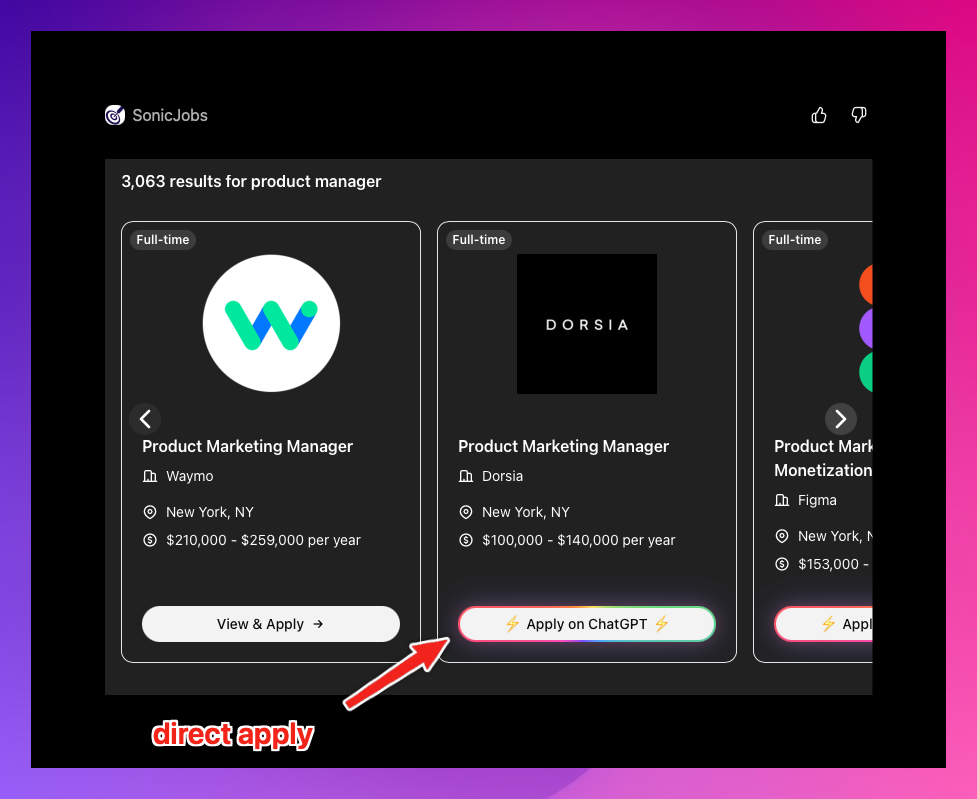
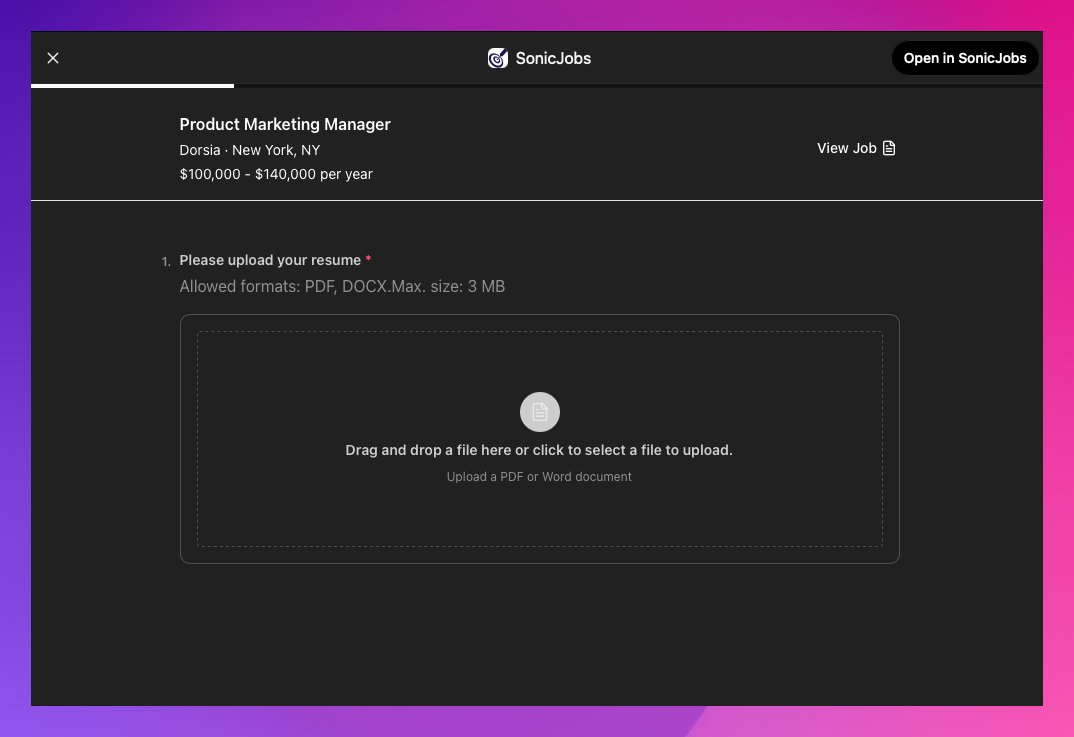
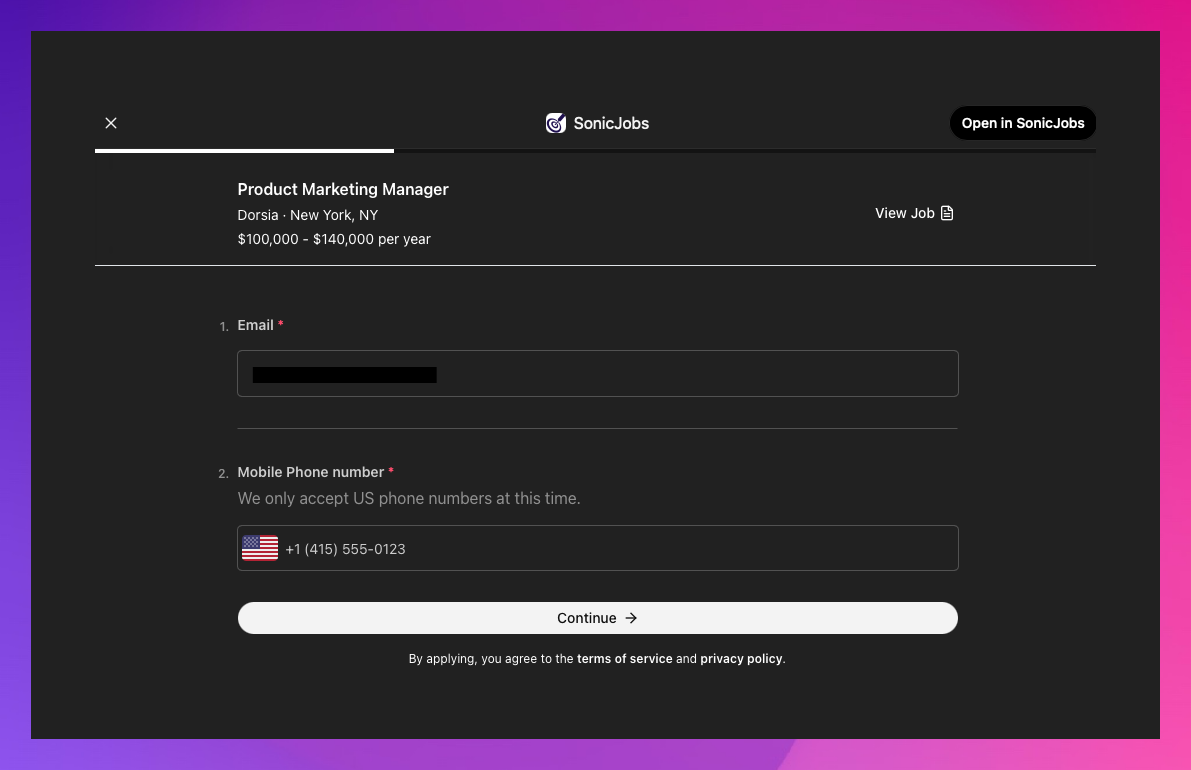
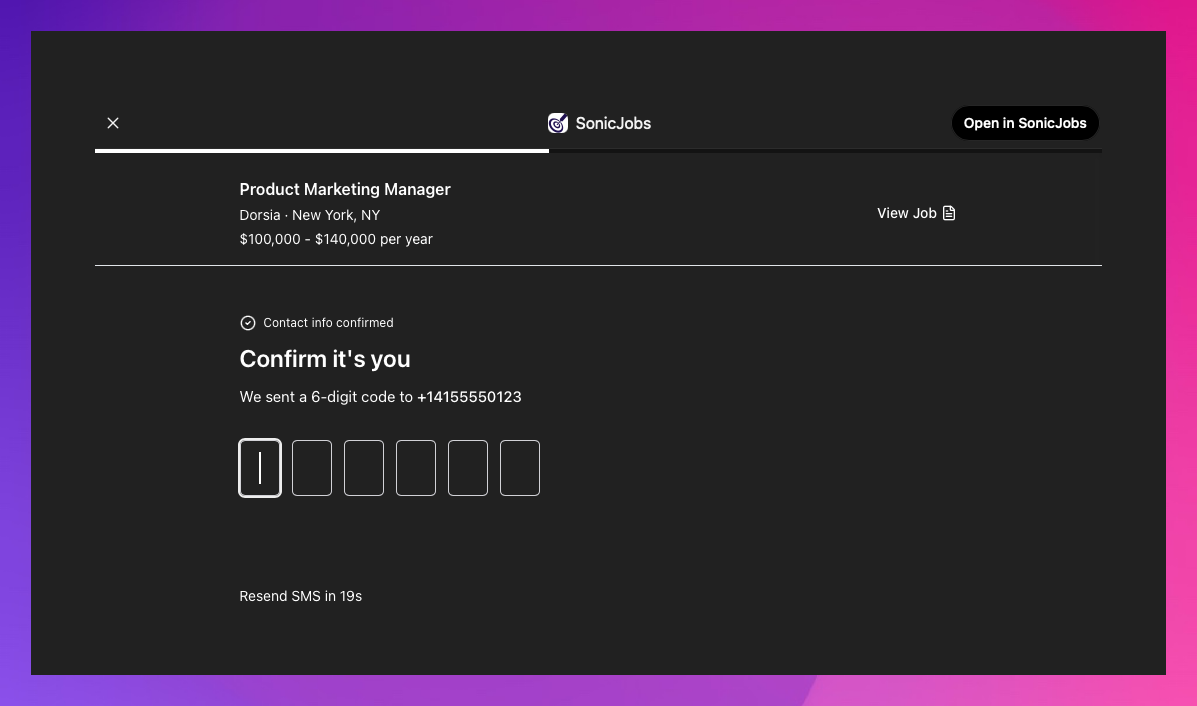
On paper, this looks like a complete, end-to-end experience.
And to be fair to SonicJobs, it is not just on paper - they have actually executed it. The remaining question is a different one: not whether they have built well (they have), but whether the channel itself will be where job seekers show up in the volumes the bet requires. Let’s keep digging.
The UX is rough
I tried this in ChatGPT recently. I installed one of the search apps, tagged it, and ran a few queries.
Here is what I got back for a remote Product Manager search:
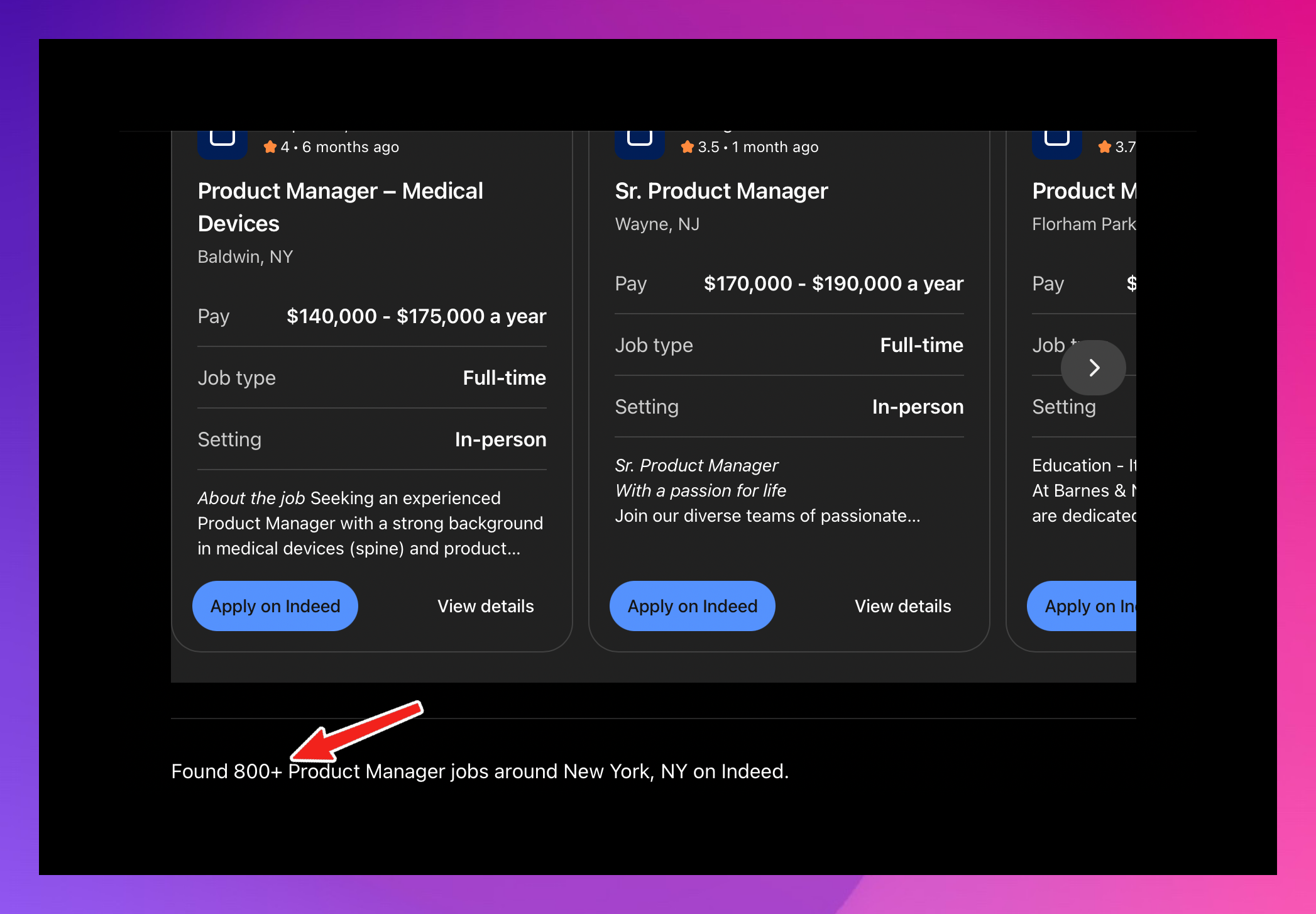
Over 500 listings, and the only way to navigate them is by typing more sentences. In a chat interface.
How is this supposed to be a better search experience than a filter-based search on a job board? I genuinely don’t know. On any half-decent job board, I can apply a remote filter, a function filter, and a couple of keyword filters and get to a usable shortlist in under a minute. In ChatGPT, I get a number and an offer to keep narrowing — which means more turns, more text, more friction. There is no map of the result space, no faceted filter sidebar and no sort options I can scan visually.
Indeed even allows me to show the results in the good old two-column view — same as if I am on Indeed, but with fewer filters and a worse experience. Inception yet?
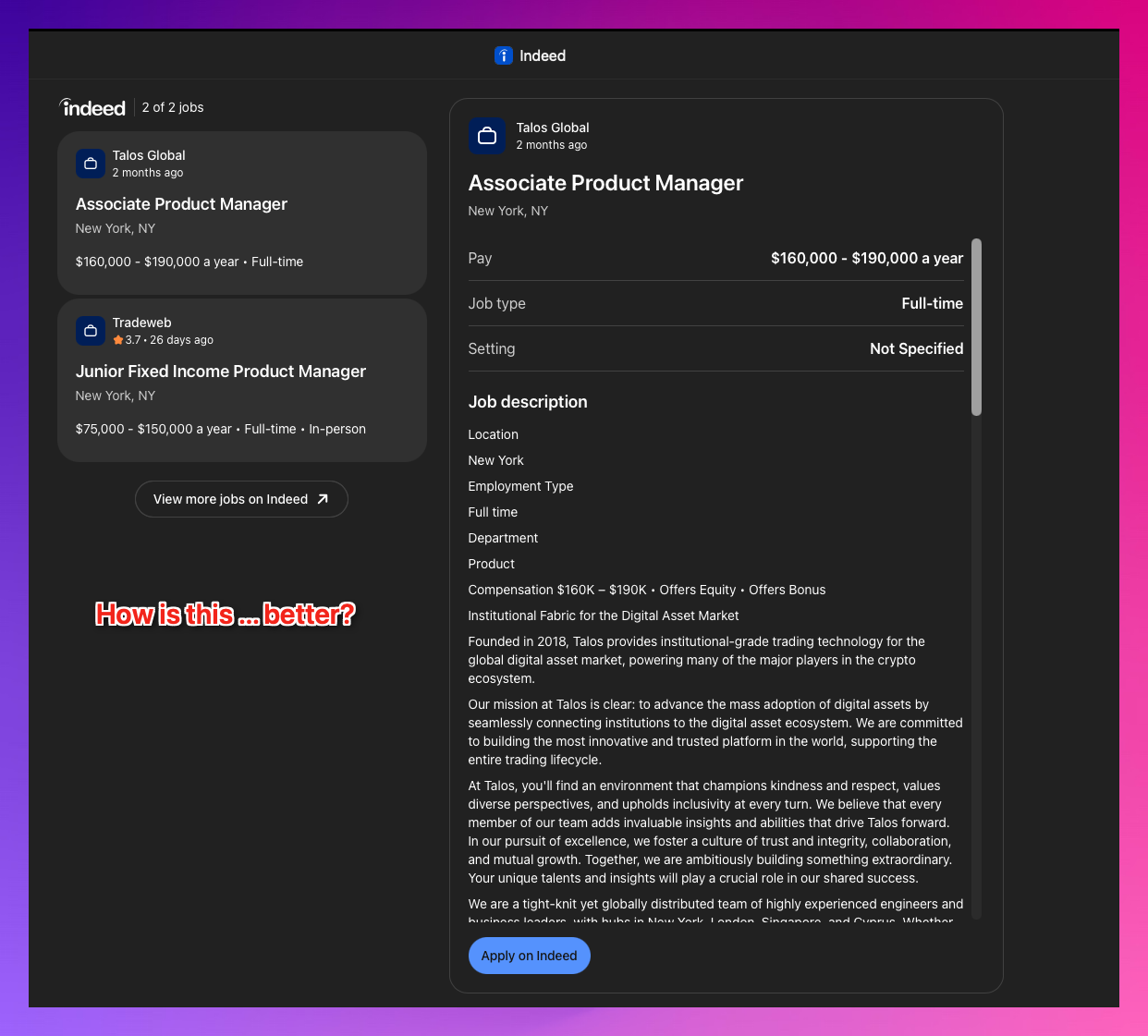
This is the gap between “the technology works” and “the user experience is good enough that anyone will switch.” Right now, it isn’t.
Five reasons I am not betting on this exploding
So here is why I think the apply-on-ChatGPT moment will not actually become the moment.
1. Every previous iteration of this has flopped. Custom GPTs, Plugins — both were going to be the App Store of LLMs and they failed. The pattern of OpenAI launching a developer surface, hyping it, and then quietly de-prioritizing it is well established. Apps and Connectors are the third try. Maybe it is the one that sticks. But the prior one failed.
2. Chat-based, LLM-powered job search products have been around for a while and have not gained traction. There were dozens of them. None broke through; most are pivoting. Xing also built an AI search, and it got zero media traction (I covered it here). It is a great feature and a very good implementation, but no one is talking about it.
The biggest tell for me has always been that Indeed could slap an AI-powered chat search on the front of their site in one or two days if they thought it would move the needle. They are not doing it. Just sayin’.
3. LLM referral traffic to job boards is currently 1–2% if it shows up at all. Across roughly 300 job board properties I have visibility into, traffic from ChatGPT, Perplexity, and Claude is marginal. The reasons for this are well understood — most people simply do not search for jobs the way they ask ChatGPT for restaurant recommendations or how to get rich. I have written about why LLM rankings work the way they do for job boards, and the short version is that even if you do everything right, the share of searches that originate in an LLM is small, and the conversion path is messy.
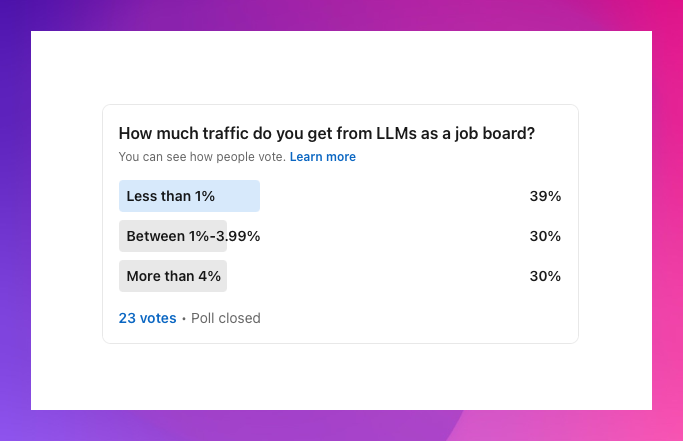
This may change if a site has a ChatGPT app, so I am open to revising this point.
4. Employers do not want another channel of AI-augmented, “perfect” applications. Why hasn’t Indeed enabled Apply in ChatGPT yet?
This is the most underrated point. Recruiters are already drowning. The whole reason auto-apply tools have such a contentious relationship with employers is that they generate applications faster than humans can screen them. ChatGPT-powered apply, with an LLM writing a tailored CV per role, is auto-apply with better packaging. Why would a TA leader voluntarily plug into a channel that pushes more of exactly the thing they are trying to filter out? To be clear — this is not a knock on what SonicJobs has built; the candidate-side experience they ship is a real step up. It is a question about employer-side appetite for the output, which is a separate problem from the quality of the build.
The argument that “AI on the employer side will catch up” is not wrong in the long run, but in the short run, the asymmetry runs against this channel.
5. OpenAI can wipe all of this out overnight. Apps rely on users finding them, installing them, and tagging them in a conversation. If OpenAI launches a native job search inside ChatGPT — and the feature flags in their frontend code suggest they are at least testing this — every third-party job search app becomes redundant. The app developer ends up either being the inventory provider that OpenAI strikes a deal with (one or two winners, like the Indeed partnership), or they get squeezed out.
Building a business that depends on OpenAI not building the obvious adjacent product is not where I want to be standing.
The counter-argument I got — and why I am still not fully convinced
The original post I put on LinkedIn drew a thoughtful critique from Mikhil at SonicJobs, who is taking the opposite view and is closer to the source than I am. He does make a few good arguments, and I have tons of respect for what the SonicJobs guys have built and they are pioneers in delivering applications without ATS integrations, so I want to take some time to go through it.
In the end, I have a high conviction, but I am also willing to change my mind if arguments are strong.
He makes a few points in his post, the most important one being about ChatGPT offeering an “SEO 2.0” opportunity. In short, he says:
“Every TA and HR leader should ask themselves whether they want AI discovery (call it “SEO 2.0”) to play out the same way as SEO 1.0 did. The cost of not investing in Google early was becoming reliant on Indeed for the next 15 years. The cost of not investing in ChatGPT and Claude early could be the same kind of dependency. There are entire teams at OpenAI and Anthropic building Apps and Connectors. Billions of weekly users. The internet is shifting from a world where LLMs pull content from your site to a world where you push structured, actionable content into the LLM ecosystem via Apps and Connectors. Indeed already gets it. Everyone else needs to move faster.”
It is a lot of good arguments. I do not dismiss it, and I want to thank Mikhil for taking the time to write this post. With the AI slop lately, it is rare to read good posts on LinkedIn.
The historical parallel to SEO 1.0 is fair, and being early to a channel does compound — Indeed’s position today is partially built on being early to Google when the rest of the industry was asleep. It works out well for them.
Where I disagree is on the mechanics, and I think the mechanics are what determine whether a channel actually works:
The current UX returns thousands of jobs per query, with no clear way to narrow them down. App installation and tagging are real friction — most users will not do it without a strong reason, and there isn’t one yet. There is no clarity that employers want to plug into a source of AI-augmented applications, which is what the “apply directly from chat” flow produces. And on actual data — not promises, but data — LLM referrals to job boards remain in the 1–2% range. That is across hundreds of properties, globally.
The SEO 1.0 analogy is not perfect either. In 2007, Google was already where consumer attention was, and the question was just how to capture it. With ChatGPT job search in 2026, consumer attention for job search is not there yet — and the data is pretty clear on this (at least the one we have).
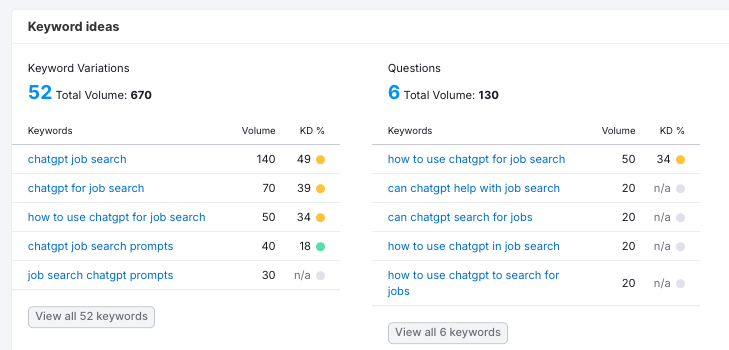
iHire’s 2025 State of Online Recruiting Report surveyed 1,421 job seekers and found that just 6.9% use generative AI platforms like ChatGPT to search for work opportunities. Huntr’s 2025 Annual Job Search Trends Report, which tracked 1.7 million applications across the year, shows LinkedIn capturing roughly 75–80% of all saved jobs across every quarter, with Indeed a distant second at 6–10%. ChatGPT does not show up in the breakdown at all — it is not generating enough saves to register.
The contrast that really tells the story is this: Huntr’s Q2 2025 data shows 93% of job seekers using AI tools like ChatGPT to help with resumes and cover letters. Same population, same year — and only 6.9% use it to actually search for openings. AI is already deeply embedded in the job search workflow. It is just not embedded in the discovery step, which is the step ChatGPT Apps are betting on.
So yeah, there are billions of weekly users on ChatGPT and LLMs, but the share using it for job search is very low, and the share generating measurable referral traffic to job boards is even smaller.
Investing in a channel before users show up is sometimes brilliant. More often than not, it is just expensive.
The point about OpenAI and Anthropic having teams building this — true, but those teams have also been building Custom GPTs, Plugins, and a long list of other developer surfaces that did not become the durable channel they were pitched as. Look at OpenAI’s exit from E-commerce.
The presence of a team is evidence of effort, not of outcome.
So I take the SonicJobs view seriously. I just think the bet is being made on a thesis (“this will become the new Discovery Channel”) that the data does not yet support. And to be clear about where the disagreement actually lives: it is not about whether SonicJobs has built a great product (they have), or whether they are early to a real surface (they are).
It is about whether the surface itself becomes the new front door for job search in the timeframe people are betting on. If anyone is positioned to prove me wrong on that, it is them - and I would be happy to be wrong because the current UX on an aggregator is awful.
SEO 1.0 was stickly for 20 years - and it still is - do me a favour and search for any job related term on Google - Indeed will be still #1-3 in most cases. This is not going away. A ChatGPT app is not yet sticky.
My take
I am not saying job search won’t change significantly in the next two to three years. It absolutely will. The mix of LLM-augmented search, agent-based apply, and shifts in how candidates research employers will remake parts of the funnel.
But the specific bet that “applying for a job on ChatGPT” becomes the channel — the way Google Jobs was supposed to be the channel in 2017, the way Custom GPTs were supposed to be the channel in 2023 — that is the bet I am not making.
If you are a job board operator and you have spare engineering capacity, building a ChatGPT App is cheap insurance. Do it. Get the integration in place, claim the namespace and monitor what happens. The work is not wasted.
But if you are deciding between investing in a ChatGPT App or, say, fixing your structured data, your apply funnel, or your retention email program — the latter will return more for you in the next 12 months. By an order of magnitude.
I will happily revisit this post in six months and delete all of this if I am wrong. But for now, my money stays where the users actually are — and the users, today, are not in the chat.
Did you like this post? Subscribe to my blog and be notified when the next one goes live!
Quoted Sources: